
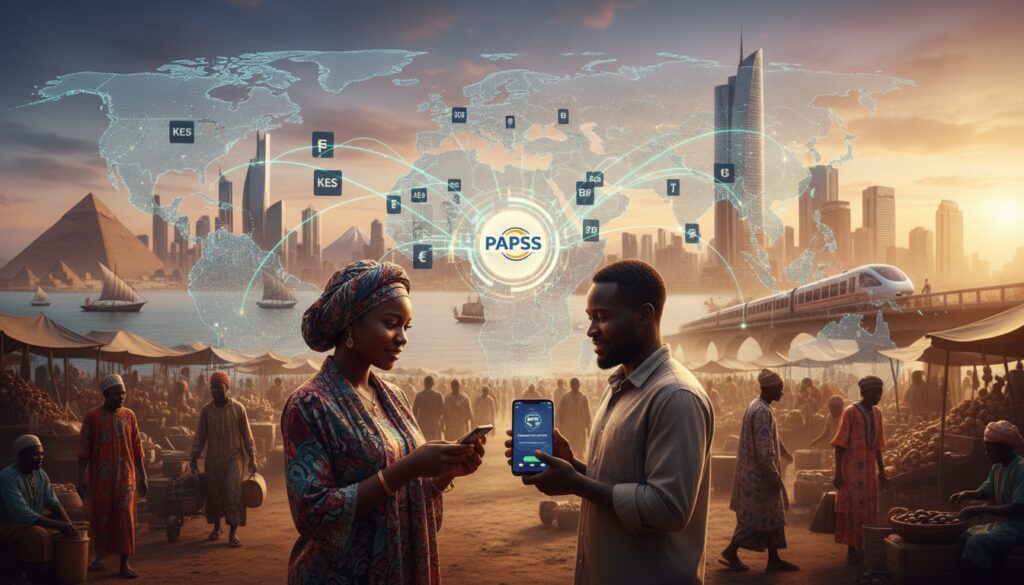
Africa’s Quiet Revolution: How PAPSS is Changing Trade
Imagine you’re a business owner in Ghana wanting to buy goods from a supplier in Kenya. What’s the easiest way to pay them? For a long time, this simple act of cross-border trade in Africa has been surprisingly complicated and expensive.
Many African businesses have had to convert their local currency into US Dollars, send the Dollars, and then the receiver converts them back into their local currency. This process is not only slow and costly but also ties African economies to the US Dollar in ways that limit their own growth.
But a quiet revolution is underway! Africa is taking a huge step towards economic independence with the Pan-African Payment and Settlement System, or PAPSS.
This innovative system is designed to make trading across African borders as easy as making a local payment, bypassing the need for the US Dollar. It’s a game-changer, especially for the ambitious African Continental Free Trade Area (AfCFTA).
The Dollar Dilemma: Why Africa is Seeking a New Path
For decades, if a company in Nigeria wanted to pay a supplier in South Africa, they couldn’t just send Nigerian Naira directly to South African Rand. Instead, the Naira would first be converted into US Dollars.
These Dollars would then be sent through a “correspondent bank,” usually a large international bank, and finally converted into Rand for the South African supplier. Think of it like a global detour that adds unnecessary miles to your journey.
This reliance on the US Dollar creates several problems. First, it’s expensive. Each currency conversion comes with fees, and these costs add up, making goods more expensive for consumers and reducing profits for businesses. Second, it’s slow. These international transactions can take days, sometimes even weeks, to settle. In today’s fast-paced world, delays mean lost opportunities and frustration. Third, it ties African economies to the policies and stability of a foreign currency, limiting their monetary sovereignty – their ability to control their own money systems.
This “dollar detour” has been a major roadblock for intra-African trade, which is trade between African countries. The African Continental Free Trade Area (AfCFTA) aims to boost this trade significantly, but it can’t truly flourish if payments remain cumbersome and costly. The need for a simpler, cheaper, and faster way to pay across borders became clear.
Enter PAPSS: Africa’s Own Digital Bridge for Trade
Recognizing these challenges, African leaders and financial institutions came together to create PAPSS – the Pan-African Payment and Settlement System. Imagine a digital highway built specifically for African currencies.
PAPSS allows businesses and individuals in one African country to pay in their local currency to someone in another African country, who then receives the payment in their own local currency, all without needing to touch the US Dollar.
How does it work? When a payment is initiated through PAPSS, it goes through the central banks of the participating countries. These central banks act as trusted intermediaries, settling the transactions directly with each other. This direct settlement means fewer steps, fewer intermediaries, and significantly lower costs. Instead of multiple currency conversions and international bank fees, PAPSS offers a single, streamlined process.

The benefits are huge. Businesses save money on transaction fees, making their goods and services more competitive. Payments settle much faster, often in real-time or within a few hours, improving cash flow and business efficiency. Most importantly, PAPSS reduces Africa’s dependence on foreign currencies, giving African countries more control over their own economic destinies.
It’s a critical piece of the puzzle for making the AfCFTA a roaring success, turning the vision of a single African market into a practical reality.
A United Front: Collaboration Driving the PAPSS Vision
PAPSS isn’t just a technical system; it’s a powerful symbol of African unity and collaboration. Its success hinges on the widespread participation of financial institutions across the continent.
Various African central banks, commercial banks, and payment service providers have joined forces to make this system a reality. It’s a massive undertaking that requires coordination and trust among diverse economies and regulatory environments.
This collaborative spirit is vital. When you see different African nations, with their unique economic structures and currencies, all agreeing to integrate their payment systems, it speaks volumes about a shared vision for the continent’s future. It shows a commitment to breaking down economic barriers and building stronger intra-African ties.
The involvement of these institutions ensures that PAPSS is not just a concept but a practical, widely adopted tool that can truly transform how trade is conducted across Africa.
This collective effort strengthens the overall financial infrastructure of Africa, making it more resilient and independent.
It demonstrates that when African countries work together, they can overcome significant challenges and build innovative solutions tailored to their specific needs, rather than relying solely on global systems that may not always serve their best interests.
Money Matters: How Exchange Rates and Stability Play a Role
When you’re dealing with different currencies, exchange rates are always a factor. An exchange rate tells you how much one currency is worth compared to another. For example, how many Nigerian Naira you get for one US Dollar. For cross-border payments to be smooth and predictable, stable exchange rates are very helpful.
If exchange rates jump up and down wildly, businesses face uncertainty, making international trade riskier and harder to plan.
Research has shown that when countries have more stable exchange rates, or even consider common currency approaches (like the Euro in Europe, though Africa’s path is different), people and businesses are more likely to use cross-border payment systems.
PAPSS, by facilitating direct payments in local currencies, helps to reduce the number of times currencies need to be converted to the US Dollar, which can indirectly contribute to more predictable local currency dynamics.
While PAPSS doesn’t create a single African currency, it creates a mechanism where the underlying exchange rate between, say, the Ghanaian Cedi and the Kenyan Shilling can be handled efficiently and transparently. This reduces the “friction” caused by multiple conversions and helps businesses better manage their costs and revenues, fostering an environment where trade can thrive with greater confidence and less financial risk.
Real-World Impact: Solving Traders’ Headaches
Let’s consider the everyday challenges faced by cross-border traders, especially small and medium-sized businesses in regions like COMESA (Common Market for Eastern and Southern Africa). Imagine a craft seller in Uganda wanting to sell their beautiful handmade goods to a buyer in Zambia. Traditional banking methods are often too expensive, with high transfer fees that eat into small profit margins.
Plus, they can be slow, tying up money that small businesses desperately need for daily operations.
On the other hand, mobile money, while popular for local payments, often has low limits for international transactions. A trader might need to send or receive amounts larger than what mobile money platforms allow, forcing them back to the slow and costly traditional banks.
This creates a bottleneck, preventing small businesses from growing and participating fully in the larger African market.
PAPSS steps in as an innovative and interoperable digital payment solution. It offers a way to overcome these hurdles by providing a system that is both affordable and capable of handling larger transaction volumes than typical mobile money services, while being much faster and cheaper than traditional bank transfers.
It means that our Ugandan craft seller can receive payment from Zambia quickly and affordably, directly in their local currency, allowing them to reinvest in their business faster and expand their reach across the continent.
Beyond Payments: PAPSS in the Grand Scheme of African Integration
The development and adoption of PAPSS is more than just about making payments easier; it’s a powerful statement about Africa’s broader vision for integration and self-reliance. This payment system is a cornerstone of the African Continental Free Trade Area (AfCFTA), which aims to create a single market for goods and services across the continent.
For AfCFTA to truly succeed, money needs to move as freely as goods and people.
In a world facing increasing global pressures – things like protectionism (countries trying to protect their own industries by limiting trade) and sometimes reduced foreign aid – Africa is strategically positioning itself for greater political and economic progress.
By building its own robust financial infrastructure like PAPSS, the continent is taking charge of its destiny. It’s reducing vulnerabilities to external economic shocks and asserting its monetary sovereignty.
This move towards financial independence empowers African nations to drive their own development agendas. It fosters a sense of collective strength and demonstrates Africa’s capability to innovate and lead on the global stage.
PAPSS isn’t just a payment system; it’s a tool for empowerment, enabling faster, cheaper trade, and paving the way for a more integrated, prosperous, and self-sufficient Africa.
Conclusion: A New Dawn for African Trade
Africa’s journey towards greater economic integration and monetary sovereignty is gaining significant momentum, and the Pan-African Payment and Settlement System (PAPSS) is at the heart of this transformation.
By offering a direct, efficient, and cost-effective way to conduct cross-border transactions in local currencies, PAPSS is quietly but powerfully bypassing the traditional reliance on the US Dollar, which has long constrained intra-African trade.
From lowering transaction costs and speeding up settlement times to supporting the ambitious goals of the AfCFTA and empowering small traders, PAPSS is more than just a payment system. It’s a strategic move towards a more connected, resilient, and economically independent continent.
As more nations and financial institutions adopt this innovative solution, Africa is not just building a payment system; it’s building a brighter, more unified future for its people and businesses.
This article was generated using the Buzz AI Growth Engine. Try it for yourself and start generating content today!
I wonder whether there are continents other than Africa considering this trading within their own borders using their own currencies. Then use the dollar $ when necessary.
If this works out extremely well, it would be great if Africa was the world leader? It would be good to hear what members think about this [in this section] please!
Such a gift of knowledge to
This site is well worth taking part in. A real gift to all of us.
Spend as much time as you can absorbing these contents .I look at them as and when they attract my attention