

Discussions about unidentified anomalous phenomena (UAPs also known as UFOs)—once relegated to the fringes of conspiracy theory—are gaining mainstream traction, while a former Bank of England expert is sounding the alarm on an unconventional threat: the economic chaos that could ensue from official confirmation of extraterrestrial life.
Helen McCaw, who served as a senior analyst in financial security at the UK’s central bank until 2012, has penned a letter to Governor Andrew Bailey, imploring the institution to develop contingency plans for what she terms “ontological shock.”
McCaw’s concerns stem from the growing chorus of high-profile figures in the United States acknowledging the possibility of non-human intelligence.
From former Director of National Intelligence James Clapper to Senators Marco Rubio and Kirsten Gillibrand, officials have publicly entertained the idea that UAPs could represent advanced technology beyond human capabilities.
Rubio, in a recent documentary, highlighted repeated incursions over restricted nuclear facilities, stating, “We’ve had repeated instances of something operating in the airspace over restricted nuclear facilities, and it’s not ours.” Even former President Barack Obama has weighed in, noting unexplained footage of objects defying known physics.
Adding to the momentum, recently declassified British military files reveal efforts to acquire “extraterrestrial” technology based on credible intelligence about UAPs outperforming human aircraft. McCaw argues that dismissing these developments as mere speculation is no longer viable.
“The United States government appears to be partway through a multi-year process to declassify and disclose information on the existence of a technologically advanced non-human intelligence,” she wrote, warning that such a revelation could upend global perceptions of power and reality itself.
The Financial Ripple Effects of “Ontological Shock”
At the heart of McCaw’s plea is the potential for widespread psychological and economic disruption. She envisions a scenario where an irrefutable announcement—perhaps from the White House—triggers immediate market turmoil.
“If there is an official announcement and we get presented with very clear evidence that nobody is going to dispute, I would say that in a matter of hours, you are going to have total financial instability,” McCaw told reporters.
Key risks outlined include:
- Extreme Market Volatility: Investors might oscillate between catastrophizing and euphoria, leading to a collapse in confidence. Traditional asset pricing models could falter as participants grapple with the implications of superior alien technology.
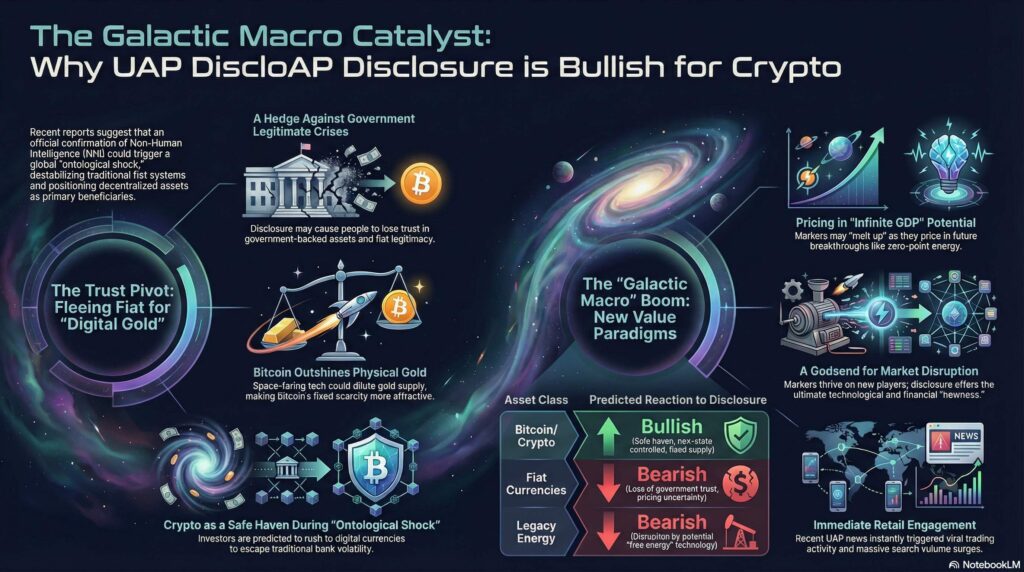
- Shifts in Safe Assets: A rush toward perceived havens like physical gold, precious metals, or government bonds could occur. Conversely, speculation about space-faring tech flooding the market with new supplies might devalue these commodities.
- Rise of Digital Currencies: In a crisis of trust in government-backed systems, decentralized assets like Bitcoin could surge in appeal. McCaw notes that people might question the legitimacy of fiat currencies, viewing cryptocurrencies as more resilient.
- Banking System Strain: An unprecedented run on banks could collapse payment systems, halting everyday transactions like buying fuel or groceries. This, in turn, might spark civil unrest and riots.
McCaw emphasizes that even if the probability seems low, the stakes demand preparation. “Even if you feel it’s very unlikely, it’s madness not to consider it and plan accordingly,” she said.
From Skeptic to Advocate: McCaw’s Journey
A Cambridge graduate with a decade at the Bank of England, McCaw’s interest in UAPs was sparked unexpectedly by a 2021 NASA paper on UFO sightings in classical antiquity, authored by astronomer Dr. Richard Stothers.
“I just thought it was a Hollywood thing and that it was only backwards people that saw them,” she admitted. “I didn’t know that governments were studying them.”
Since leaving the Bank for roles in wealth management and financial technology, McCaw has faced skepticism from peers and even friends. Her husband was initially doubtful but now recognizes the issue’s gravity. Undeterred, she’s contributing a chapter to an upcoming book edited by Dr. Alex Wendt, a professor of international security at Ohio State University, to bridge the gap between UAP discourse and policy circles.
She avoids niche UFO podcasts, focusing instead on briefing government officials. “The whole UFO community is just a bit Wild West,” McCaw explained. “I don’t need to convince people who already know this is real.”
Broader Implications and the Path Forward
This call to action arrives amid predictions from figures like documentary producer Dan Farah, who believes a U.S. president will soon announce we’re not alone. The Bank of England has declined to comment, but McCaw’s warnings underscore a shifting paradigm: what was once science fiction is now a potential regulatory reality.
As astronomical discoveries like the recent interstellar comet 3I/ATLAS continue to captivate, the intersection of space exploration and economic stability grows more pertinent. Institutions worldwide may soon need to integrate such “black swan” events into their risk assessments, ensuring resilience against shocks from beyond our world.
While the existence of alien life remains unproven, McCaw’s proactive stance serves as a reminder: in finance, as in the cosmos, preparation is key to navigating the unknown.
Article by Abundance Thinker