
Africa’s Grand Divorce: Is the Continent Really Splitting Apart?
The internet loves a good dramatic headline, and few have captured the collective imagination quite like the one proclaiming ‘Africa is splitting into two continents!’ Images of colossal fissures tearing through the landscape have gone viral, sparking both awe and a dash of panic.
Is it time to invest in beachfront property in Rwanda? Should we start rehearsing our ‘Welcome to New Africa’ speeches? Let’s dive into the fascinating, albeit incredibly slow, world of plate tectonics to unravel the truth behind Africa’s purported continental divorce.
The Star of the Show: The East African Rift Valley
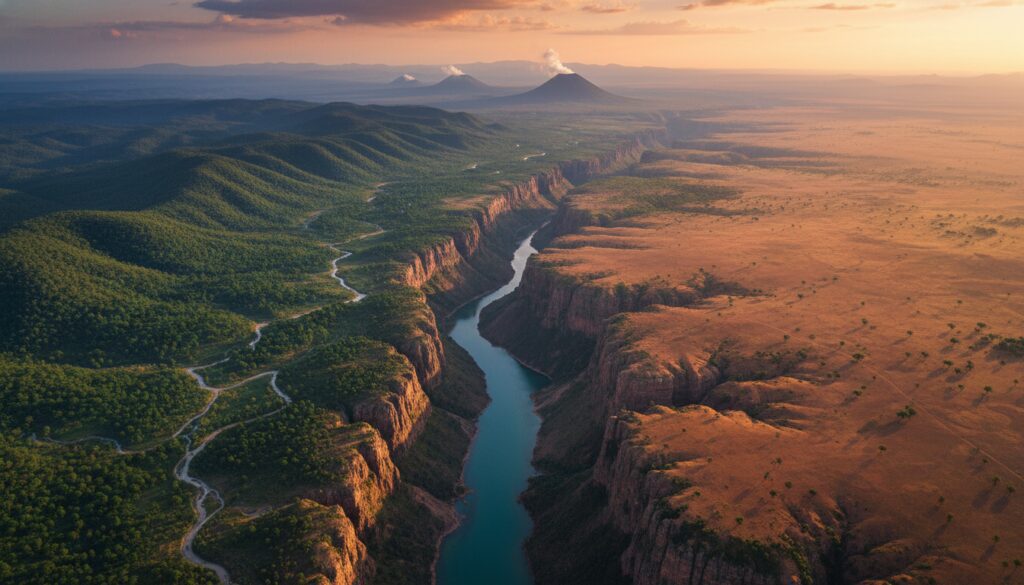
At the heart of this geological drama is the East African Rift Valley (EARV). This isn’t just a picturesque series of valleys, volcanoes, and lakes stretching thousands of kilometers from the Afar Triple Junction in Ethiopia down through Kenya, Tanzania, and beyond.
It’s a colossal, active geological construction site where two tectonic plates are slowly, steadily, and very dramatically pulling apart. Think of it as geology’s version of a very, very slow-motion breakup, where the Earth itself is doing the heavy lifting.
The EARV is a classic example of a divergent plate boundary. Unlike convergent boundaries where plates collide (creating mountains like the Himalayas) or transform boundaries where they slide past each other (causing earthquakes like along the San Andreas Fault), divergent boundaries are where new crust is formed as plates move away from each other. In the case of the EARV, the African Plate is not a single, monolithic entity but is being torn into two distinct sub-plates: the Nubian Plate (which carries most of Africa) and the smaller, eastern Somali Plate.
Cracks in the Earth: The Evidence
So, what’s the evidence for this grand separation? It’s not just theoretical; it’s visibly manifest in several ways. Perhaps the most striking are the visible fissures, sometimes kilometers long and several meters deep, that have appeared in places like Kenya.
In 2018, a particularly dramatic crack sliced through a major highway, forcing its closure. While these specific events are often exacerbated by heavy rainfall and erosion, they occur along existing fault lines, revealing the underlying tectonic stresses at play.
Beyond the surface cracks, the EARV is a hotbed of geological activity. Volcanic eruptions, though not always frequent, are a clear indicator of magma rising from beneath the thinning crust. Think of Mount Kilimanjaro, Mount Kenya, and the active volcanoes of the Afar region – they are all byproducts of this rifting process. Earthquakes are also common, usually shallow and of moderate intensity, as blocks of crust adjust and slide along the fault lines. The Afar Triple Junction in Ethiopia is a particularly intense spot, where three plates (the Nubian, Somali, and Arabian plates) are all pulling away from each other simultaneously – a truly unique geological setup.
The Long Goodbye: Time Scales and Future Landscapes
Now for the crucial caveat: when we talk about continents splitting, we’re talking about geological time, which operates on a scale that makes human lifespans seem like a blink of an eye. The plates are moving apart at a rate of a few millimeters to a couple of centimeters per year – roughly the speed your fingernails grow.
So, if you’re planning a trip to see the new ocean form, you might want to pack a very, very long-lasting lunch.
Scientists estimate that it will take anywhere from 5 to 10 million years for the rift to fully develop into a new ocean basin. When it does, the eastern portion of Africa – comprising parts of Ethiopia, Kenya, Tanzania, and Somalia – will become a large island or a new continent, separated from the rest of Africa by a new sea.
This new ocean would eventually stretch from the Red Sea down through the length of the current rift valley, creating dramatic new coastlines and potentially reshaping global ocean currents and climate patterns. Imagine a new sea, perhaps named the ‘East African Sea,’ carving its way through the landscape, flanked by volcanic islands and vibrant new ecosystems. It’s a truly humbling thought: we are living on a planet that is literally tearing itself apart, one millimeter at a time.
Why This Matters: A Living Laboratory
Beyond the sensationalism, the East African Rift Valley is a living laboratory for geologists and Earth scientists. It offers an unparalleled opportunity to study how continents break apart, how new ocean basins are formed, and how the Earth’s crust continuously reshapes itself.
By observing the processes here, scientists can gain insights into the geological past of our planet, understanding how ancient supercontinents like Pangea fragmented, leading to the world map we know today.
The unique geological conditions also influence biodiversity, creating isolated lakes and diverse ecosystems. The rift lakes, for instance, are famous for their endemic fish species, offering a natural experiment in evolution.
Furthermore, the region’s volcanic activity and rich sediments have made it a treasure trove for paleontologists, yielding some of the most significant discoveries related to human origins.
Conclusion: Don’t Pack Your Swim Trunks Just Yet
So, is Africa splitting into two continents? Yes, in a geological sense, it absolutely is. The East African Rift Valley is undeniable proof that the continent is slowly, inexorably, undergoing a grand divorce. But it’s a process measured in eons, not election cycles.
It’s a testament to the Earth’s dynamic nature, a reminder that our planet is constantly evolving, even if its changes are too slow for the human eye to perceive in real-time. While we won’t see two distinct continents in our lifetime, or even our descendants’ lifetimes, the groundwork for this monumental transformation is being laid right now, beneath our very feet.
It’s a thought-provoking glimpse into the Earth’s relentless power and its profound ability to reshape itself over unimaginable stretches of time. So next time you hear the news, remember: the Earth works on its own timeline, and sometimes, the most dramatic changes are the ones you can’t see happening, but are nonetheless profound.
This article was generated using the Buzz AI Growth Engine. Try it for yourself and start generating content today!