
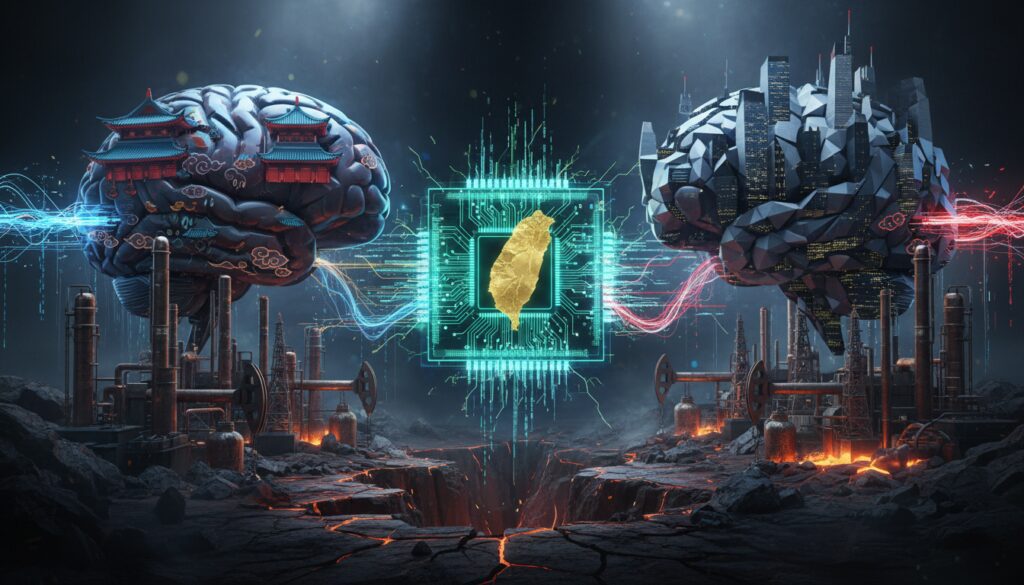
AI Dominance: It’s Not Just Code, It’s Oil and Taiwan
The race for artificial intelligence (AI) dominance between the United States and China is often framed as a battle of algorithms, data sets, and technological prowess. We hear about supercomputers, machine learning breakthroughs, and the sheer volume of research papers.
But what if that’s only half the story?
What if the true determinants of AI supremacy aren’t just in Silicon Valley or Zhongguancun, but in the oil fields of the Middle East and the semiconductor factories of a small island nation?
This isn’t a theory for the faint of heart; it’s a stark, controversial look at the gritty, geopolitical underbelly of the AI revolution.
The AI Gold Rush: Why It Matters So Much
AI is the new electricity, the new industrial revolution. It promises to transform everything from healthcare and finance to warfare and governance. The nation that masters AI will wield unparalleled economic power, military might, and geopolitical influence.
For China, AI is central to its ‘Made in China 2025’ ambitions and its vision of a ‘digital authoritarianism’ that can enhance state control. For the US, AI is crucial for maintaining its technological edge, fostering innovation, and securing its democratic values against emerging threats.
The stakes couldn’t be higher, making every strategic advantage, no matter how seemingly tangential, absolutely critical.
China’s AI Machine: Data, State, and Ambition
China’s approach to AI is characterized by massive state investment, a vast population generating unparalleled data, and a top-down strategic vision.
Beijing has set ambitious targets, pouring billions into research, development, and deployment. Its ‘AI Four Dragons’ – Baidu, Alibaba, Tencent, and SenseTime – are global leaders, backed by a government that sees AI as a national imperative.
The sheer volume of data, often unburdened by Western privacy norms, provides a fertile ground for training sophisticated algorithms. This state-centric model, some argue, allows for a coordinated, long-term strategy that private-sector-led economies struggle to match.
It’s a powerful engine, but every engine needs fuel.
America’s AI Edge: Innovation, Talent, and Openness (Mostly)
The US, by contrast, relies on its vibrant private sector, world-leading universities, and a culture of innovation and entrepreneurship. Companies like Google, Microsoft, Amazon, and OpenAI are at the forefront of AI research, attracting top global talent.
The American ecosystem fosters breakthroughs through competition and collaboration, often leading to more generalized and adaptable AI solutions.
Its strength lies in its ability to attract and retain the brightest minds globally, and its robust venture capital system fuels rapid scaling of new technologies.
However, even the most brilliant minds and innovative companies cannot function in a vacuum, especially when foundational resources are threatened.
The Unseen Fuel: Oil’s Critical Role in AI
Here’s where the narrative takes a controversial turn. AI, at its core, is a ravenous consumer of energy.
Training complex AI models requires immense computational power, which means vast data centers humming with thousands of GPUs, all needing constant electricity.
This isn’t just about plugging into a wall socket; it’s about national energy security. China, despite its strides in renewables, remains heavily reliant on imported oil and gas, particularly for its industrial base and transportation – the very infrastructure that supports its digital ambitions.
A disruption in global oil supplies, or a significant price hike, could cripple China’s ability to power its burgeoning AI infrastructure, slowing down research, deployment, and even manufacturing of AI-enabled devices.
The US, having achieved significant energy independence through shale, finds itself in a comparatively stronger position.
The ability to guarantee cheap, stable energy is not just about keeping cars running; it’s about keeping the AI algorithms learning.
To ignore oil’s foundational role is to misunderstand the very physics of AI development.
Taiwan: The Microchip Kingpin and Geopolitical Chess Piece
Now, let’s talk about Taiwan – an island nation that, for many, is simply a point of geopolitical tension.
But for AI, Taiwan is nothing short of indispensable. Taiwan Semiconductor Manufacturing Company (TSMC) is the world’s leading foundry for advanced microchips, producing over 90% of the most cutting-edge processors – the very brains of all advanced AI systems.
From your smartphone to supercomputers, if it’s cutting-edge AI, it’s likely running on a chip made in Taiwan. Without these chips, the AI race grinds to a halt. Neither the US nor China can produce these advanced chips at scale or with comparable quality.
China desperately wants to bring Taiwan under its control, not just for historical or territorial reasons, but for a strategic chokehold on the global technology supply chain, specifically semiconductors. For the US, defending Taiwan’s autonomy isn’t just about democratic principles; it’s about safeguarding its own technological future and preventing an adversary from gaining an insurmountable lead in AI by controlling its essential hardware.
The fate of Taiwan, therefore, is not merely a regional dispute; it is arguably the single most critical flashpoint in the global AI dominance struggle.
Whoever controls Taiwan’s factories controls the future of AI.
The Intertwined Destinies: A Complex Web
The AI dominance race between China and the US is not a clean, digital contest. It’s a messy, interdependent struggle where traditional geopolitical factors – energy security and strategic resources like semiconductors – are inextricably linked to technological advancement.
China’s AI ambitions, for all their impressive momentum, are vulnerable to its energy dependencies and its inability to produce advanced chips independently.
The US, while possessing greater energy security and a lead in certain AI innovation areas, remains critically reliant on Taiwanese semiconductor manufacturing.
Any disruption to oil supplies or, more catastrophically, a conflict over Taiwan, would send shockwaves through the global AI ecosystem, potentially resetting the entire race.
The winner of the AI dominance game won’t just be the one with the smartest algorithms; it will be the one with the most secure access to the fundamental resources that power and enable those algorithms. This isn’t just about bytes and bits; it’s about barrels and factories, making the AI race far more dangerous and complex than most are willing to admit.
This article was generated using the Buzz AI Growth Engine. Try it for yourself and start generating content today!