
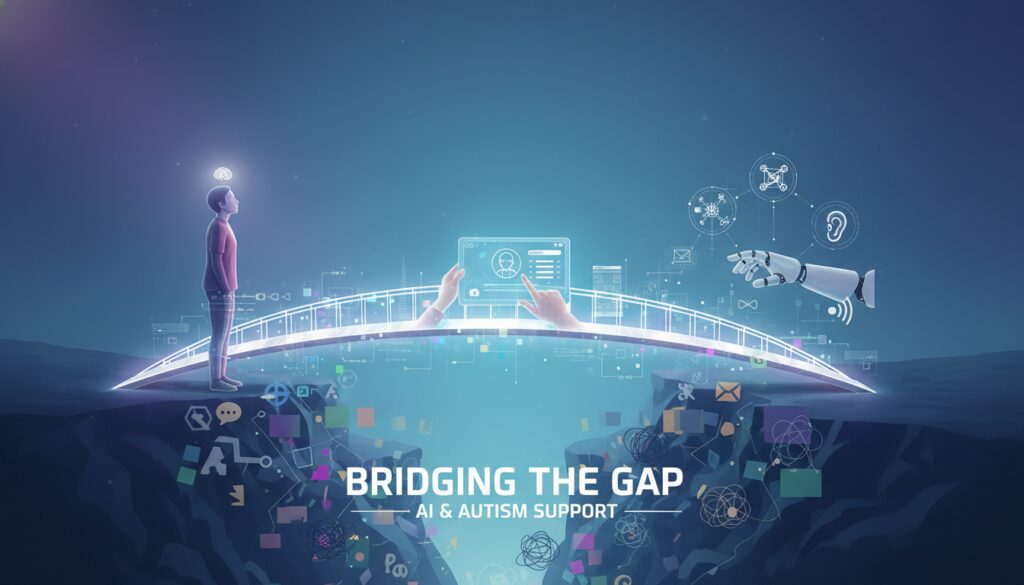
Bridging the Gap: How Artificial Intelligence is Revolutionizing Support for Severe Autism
For families and individuals navigating the complexities of severe autism, life presents a unique set of challenges. Characterized by significant impairments in communication, social interaction, and often accompanied by repetitive behaviors, sensory sensitivities, and co-occurring medical conditions, severe autism demands intensive, highly individualized support.
Following is an Audio Discussion on this topic
Historically, interventions have relied heavily on human-intensive therapies, which, while invaluable, can be resource-intensive and lack the scalability needed to reach everyone. Enter Artificial Intelligence (AI) – a rapidly evolving field that is now emerging as a powerful ally, offering innovative solutions to enhance diagnosis, personalize therapies, facilitate communication, and improve the daily lives of those with severe autism.
Understanding the Landscape of Severe Autism
Severe autism represents the more profound end of the autism spectrum. Individuals often exhibit minimal to no verbal communication, struggle significantly with social reciprocity, and may engage in challenging behaviors such as self-injury or aggression. Sensory processing differences can be extreme, leading to distress in common environments.
The goal of intervention is often to improve functional communication, reduce challenging behaviors, foster independence in daily living skills, and enhance overall quality of life. Achieving these goals requires a deep understanding of each individual’s unique profile and highly tailored strategies – an area where AI’s analytical power shines.
AI for Earlier Detection and Diagnosis
Early intervention is paramount in autism, but diagnosis, particularly of severe forms, can be delayed. AI is beginning to transform this by analyzing subtle behavioral patterns that might be missed by the human eye. Machine learning algorithms can process vast amounts of data from infant vocalizations, eye-tracking patterns, video recordings of social interactions, and even genetic markers.
By identifying predictive indicators at younger ages, AI can flag individuals at high risk, allowing for earlier diagnostic confirmation and the initiation of crucial therapies during critical developmental windows. This predictive capability has the potential to significantly shorten diagnostic wait times, leading to more timely and effective support.

Personalized Interventions and Therapies
One of AI’s most profound contributions lies in its ability to personalize interventions. Traditional therapies, while effective, often follow a generalized curriculum. AI can adapt to an individual’s specific learning style, pace, and challenges, creating truly bespoke therapeutic experiences.
- Adaptive Learning Platforms: AI-driven educational software can customize curricula, present information in preferred formats (visual, auditory), and adjust difficulty levels in real-time based on a child’s responses. This creates a highly engaging and effective learning environment, often utilizing gamification to maintain interest.
- Robotic Companions: Social robots, such as NAO or PARO, are being developed to assist with social skills training. Their predictable interactions, consistent responses, and non-judgmental presence can be less intimidating than human interaction, helping individuals practice social cues, emotional recognition, and turn-taking in a safe, controlled environment.
- Virtual Reality (VR): AI-powered VR simulations offer safe, controlled environments for practicing social scenarios, navigating public spaces, or desensitizing to sensory triggers. Individuals can repeatedly experience challenging situations without real-world consequences, building confidence and coping mechanisms.
- Augmenting ABA Therapy: Applied Behavior Analysis (ABA) is a widely recognized therapy for autism. AI can assist ABA therapists by analyzing session data, identifying patterns in behavior and response, and providing data-driven insights to optimize intervention strategies, making therapy more efficient and effective.
Enhancing Communication Pathways
For individuals with severe autism who are non-verbal or minimally verbal, communication is often a primary barrier. AI is revolutionizing augmentative and alternative communication (AAC) devices:
- Advanced AAC Systems: AI-powered AAC devices offer more intuitive interfaces, predictive text, and symbol-to-speech conversion that can learn an individual’s preferences and common phrases. Some systems can even generate personalized voices, giving individuals a unique identity through their communication.
- Emotion Recognition: AI algorithms can analyze subtle facial expressions, vocal tones, and body language to help caregivers and therapists interpret non-verbal cues and understand an individual’s emotional state, needs, or distress signals. This bridges a critical gap in communication, fostering better understanding and responsiveness from support networks.
Improving Daily Living and Safety
AI’s impact extends to enhancing independence and safety in daily life:
- Smart Home Technologies: AI-powered smart home systems can be tailored to create sensory-friendly environments, adjusting lighting, sound, and temperature based on an individual’s preferences or real-time stress indicators. They can also assist with routine management, providing visual or auditory prompts for daily tasks, reducing anxiety caused by unpredictability.
- Wearable Devices: AI-enabled wearables can monitor physiological data such as heart rate, sleep patterns, and skin conductance, providing alerts for escalating anxiety or stress before a crisis occurs. For individuals prone to wandering, AI-powered GPS tracking and geofencing can provide crucial safety nets, alerting caregivers if an individual leaves a designated safe area.
Challenges and Ethical Considerations
While the promise of AI in severe autism is immense, it’s crucial to address the challenges and ethical considerations. Data privacy and security are paramount, especially given the sensitive nature of health information. Algorithmic bias is another concern; AI models must be trained on diverse datasets to ensure they are equitable and effective for all individuals, regardless of background.
Accessibility and cost remain barriers for many families, highlighting the need for affordable and widely available solutions. Finally, and perhaps most importantly, AI should always be viewed as a tool to augment, not replace, human connection and care. The invaluable role of therapists, educators, and family in providing empathy, understanding, and individualized support cannot be overstated.
A Future of Empowered Support
The integration of Artificial Intelligence into the support ecosystem for severe autism represents a paradigm shift. From earlier, more accurate diagnosis to highly personalized therapies, enhanced communication, and improved daily living, AI is unlocking new possibilities.
By fostering collaboration between AI developers, clinicians, educators, and families, we can ensure that these technologies are developed ethically, responsibly, and with the ultimate goal of profoundly improving the quality of life, fostering independence, and unlocking the full potential of every individual with severe autism.
The future promises a world where technology empowers, rather than isolates, creating pathways to a more connected and fulfilling life.
This article was generated using the Buzz AI Growth Engine. Try it for yourself and start generating content today!