
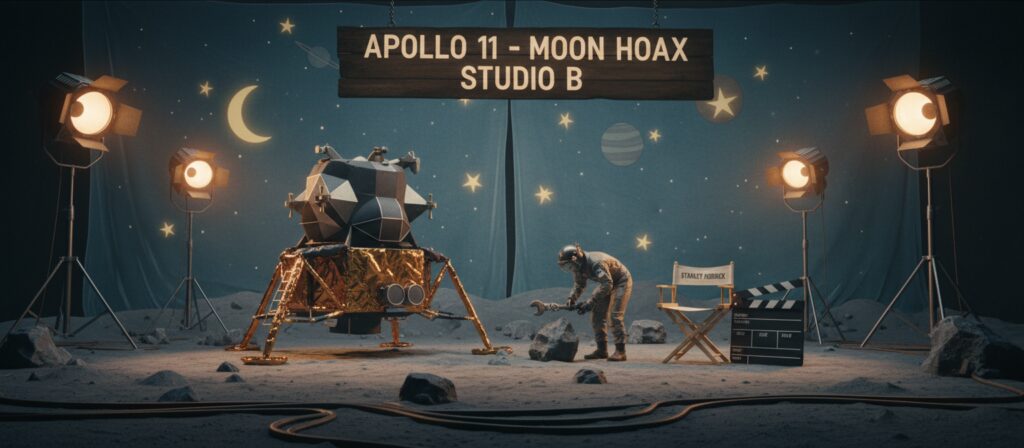
The year 1969. Humanity watched, mesmerized, as Apollo 11 supposedly touched down on the lunar surface.
Or did it? For decades, whispers and shouts have challenged this monumental achievement, pointing to a mountain of strange anomalies that just don’t add up.
Forget “conspiracy theory” for a moment, and let’s put on our detective hats! We’re diving deep into the most famous ‘inconsistencies’ of the 1969 moon landing, not to dismiss them, but to truly examine why so many intelligent people still raise an eyebrow.
Get ready to have some fun, learn a thing or two, and maybe, just maybe, see the moon landing photos in a whole new light!
The Flag Flap – A Waving Mystery in a Vacuum?
One of the most iconic images is Buzz Aldrin saluting the American flag.
But wait a minute!
Look closely.
The flag appears to be rippling, almost waving in a breeze.
Last time we checked, the moon is a vacuum.
No air, no wind.
So, how does a flag wave?
NASA’s official line? A telescopic pole and creases from storage.
But let’s be real: those look like natural ripples. Is it possible we’re seeing a flag behaving exactly as it would on a breezy soundstage, rather than the airless expanse of space? It’s enough to make you wonder if someone forgot to turn off the fan!
Where Did All the Stars Go?
The moon has no atmosphere to scatter light. From its surface, the night sky should be a dazzling tapestry of stars, far brighter and more numerous than anything we see on Earth.
So, why are there zero stars in any of the Apollo photographs or videos? NASA says the lunar surface and bright suits were so well-lit by the sun that the cameras, set for fast shutter speeds, couldn’t capture the faint starlight.
But think about it: if you’re on the moon, shouldn’t the sheer intensity of the stars still register somewhere? It feels a little too convenient, doesn’t it?
Almost like they were shooting against a black backdrop… without adding the stars later. Oops!
Shadow Play – Multiple Suns on the Moon?
Take a peek at some famous lunar landscapes. You might notice something peculiar about the shadows. They often appear to be non-parallel, converging or diverging in ways that seem inconsistent with a single, distant light source (the sun).
If the sun is the only light source, shouldn’t all shadows be parallel? Critics argue this suggests multiple light sources, like powerful studio lights, strategically placed to illuminate a set.
While perspective can play tricks, the sheer number of instances where shadows behave ‘oddly’ raises a big red flag. It’s almost like they were trying to light a movie set just right!
The Curious Case of the ‘C’ Rock
In one infamous photograph, a lunar rock clearly shows a distinct “C” mark. What’s that about? NASA’s explanation: a stray hair or debris on the negative, a ‘photographic anomaly.’
But come on! A perfectly formed “C” on a rock, in a place where we’re supposed to be exploring the unknown?
It looks suspiciously like a prop marker, telling the stagehands where to place it. In a world where every detail was supposed to be meticulously documented, this ‘C’ feels less like an accident and more like a slip-up from the set design team.
Van Allen Belts – A Radiation Roadblock?
Our Earth is surrounded by two formidable rings of intense radiation, the Van Allen Belts. Many scientists have pointed out that passing through these belts would expose astronauts to lethal doses of radiation.
NASA claims they found ‘thin spots’ and that the spacecraft provided enough shielding for the brief pass-through. But is it truly plausible that the technology of the late 60s could adequately protect humans from such a fierce, invisible enemy?
It’s a bit like driving through a hurricane in a convertible and claiming you barely got wet. Some find it hard to swallow.
The Missing Crater – Where’s the Blast Mark?
The Lunar Module used a powerful engine to slow its descent. An engine strong enough to land a spacecraft should, logically, kick up a massive amount of dust and leave a noticeable blast crater beneath it.
Yet, in the photos, the Lunar Module sits almost pristine on the surface, with barely a disturbance underneath. NASA says the engine throttled down and the exhaust spread out.
But for a landing that was supposed to be a fiery ballet of controlled power, the lack of a significant imprint feels, well, unimpressive.
Almost too clean.
Footprints in the (Dry) Dust
The moon is a bone-dry, airless environment. On Earth, we typically get clear, defined footprints in damp sand or soil. So how did the astronauts leave such perfectly preserved, crisp footprints in the lunar regolith? NASA explains that the lunar soil’s angular particles interlock in a vacuum, holding their shape.
While technically possible, it still feels counter-intuitive to our Earthly experience.
Could it be that the ‘lunar dust’ was actually a finely prepared mixture on a studio floor, designed to hold perfect impressions? Just a thought!
The Crosshairs Conspiracy – Behind the Objects?
All official NASA photos from the moon landing feature fiducial crosshairs, which are supposed to be printed on top of the image by the camera itself. But in several notorious photos, these crosshairs appear to be partially or completely behind objects in the foreground!
This is a massive photographic no-no and strongly suggests image manipulation. NASA’s excuse? Overexposure causing light to ‘bleed’ and obscure the thin crosshairs.
But for something that should be an absolute, un-obscurable reference point, this ‘bleeding’ explanation feels like a convenient way to dodge a very incriminating detail. It’s like finding a watermark underneath the picture!
Film vs. Lunar Extremes – Too Hot, Too Cold?
The lunar surface experiences mind-boggling temperature swings, from scorching hot (+120°C) during the day to freezing cold (-170°C) at night.
How did photographic film, notoriously sensitive to temperature, survive these brutal conditions? NASA says special cameras and film were used, and storage inside the module helped.
But the sheer range of temperatures and the known fragility of film make this a tough pill to swallow for many. Was the film really that advanced, or were the ‘lunar’ conditions a bit more controlled?
The Global Silence – Or Global Complicity?
Perhaps the biggest counter-argument to the hoax theory is the sheer scale of the operation and the idea that no one would leak it. Hundreds of thousands of people involved, global tracking stations (including from Cold War adversaries like the Soviet Union!). How could such a massive secret be kept?
Well, consider the power of national pride, political pressure, and the immense resources of intelligence agencies. In a Cold War race for space, the stakes were incredibly high.
Is it truly impossible that key players, even adversaries, might have had reasons to ‘go along’ or simply lack the means to definitively expose a sophisticated deception? Sometimes, silence isn’t consent; it’s simply a lack of power to speak.
Conclusion
So, there you have it – a whirlwind tour through some of the most head-scratching ‘inconsistencies’ of the 1969 moon landing.
We’re not here to tell you what to believe, but to encourage critical thinking and a healthy dose of skepticism. While official explanations exist for each of these points, many find them less than fully convincing. Is it possible that the greatest show on Earth… wasn’t actually on the moon?
The debate continues, proving that sometimes, the most fascinating journeys are not to the stars, but into the mysteries right here at home. Keep asking questions, truth-seekers!
The universe (or perhaps, the studio backlot) is full of wonders!
This article was generated using the Buzz AI Growth Engine. Try it for yourself and start generating content today!