
The Mosquito: Our Harmful But Helpful “Friend”
Ah, the mosquito. Just hearing the word probably conjures images of itchy bites, buzzing ears, and frantic swatting. It’s hard to imagine a creature more universally loathed, a tiny villain that ruins outdoor gatherings and transmits devastating diseases.
So, when someone asks, “Why do we need mosquitoes?” the immediate, gut-level response is often a resounding: “We don’t! Kill them all!”
Great question, though — and yeah, it feels wrong that something so annoying could possibly be useful. But hold onto your bug spray, because mosquitoes actually play a few quiet, unglamorous, yet surprisingly vital roles in Earth’s intricate systems.
Prepare for a paradigm shift, because these bloodsuckers aren’t as useless as you might think. Let’s dive into the fascinating, if slightly uncomfortable, truth about our buzzing “friends.”
The Unsung Heroes of the Food Chain: Tiny Bites, Big Meals
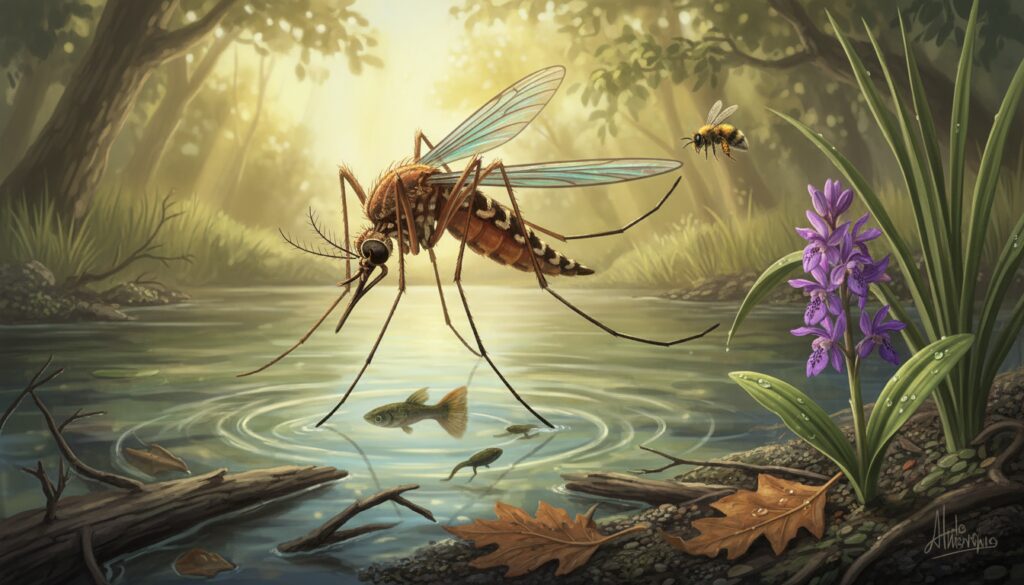
Before they become the airborne terrors we know, mosquitoes begin their lives as larvae and pupae in water. And in this aquatic stage, they are far from useless.
In fact, they are a key food source for an incredible array of creatures. Think of them as the tiny, wriggly base of a massive aquatic food pyramid.
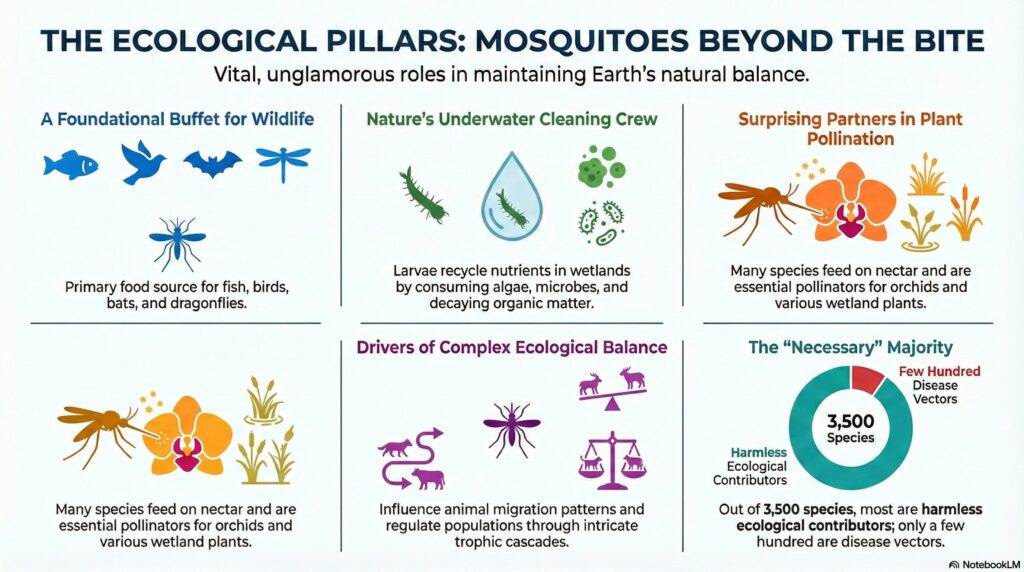
Fish, frogs, salamanders, tadpoles, dragonflies, water beetles, and even certain birds and bats feast on mosquito larvae with gusto. In many wetlands, ponds, and freshwater ecosystems, these larval stages are one of the most abundant forms of biomass available. They are a readily accessible, protein-rich snack that sustains entire populations.
Imagine a sudden, complete disappearance of mosquitoes from these environments. It wouldn’t just mean fewer bites for us; it would send shockwaves through the food chain, stressing countless species that rely on them. Predator populations would plummet, leading to a cascade of ecological imbalances. The intricate web of life is far more interconnected than we often realize, and even the smallest threads, like mosquito larvae, are crucial.
Nature’s Micro-Recyclers: Turning Gunk into Gold
Mosquito larvae aren’t just passive snacks; they’re active participants in their aquatic homes. These tiny organisms are like nature’s mini clean-up crew, diligently working to keep their watery habitats healthy. How? By feeding on a delightful buffet of algae, microbes, and decaying organic matter found in stagnant water.
This includes everything from fallen leaves to microscopic detritus that would otherwise accumulate and potentially harm the ecosystem.
Through this feeding process, mosquito larvae perform a crucial function: **nutrient recycling**. They convert this “gunk” — which is often indigestible or unusable by higher animals — into their own body mass. This body mass, in turn, becomes protein that *can* be consumed by fish, frogs, and other predators.
Essentially, they act as biological filters, taking waste products and transforming them into a valuable food source, thereby helping to clean and re-energize ponds, swamps, and wetlands. It might sound gross, but it’s an incredibly efficient and vital part of maintaining ecological balance.
The Surprising Pollinators: Not All Mosquitoes Crave Blood
This is often the most surprising revelation for many people: not all mosquitoes drink blood. In fact, only female mosquitoes bite, and they do so to obtain the protein necessary for egg production.
The vast majority of mosquitoes, both male and female, primarily feed on nectar and other plant juices for their energy needs. This makes them, inadvertently, **pollinators**.
While they might not be as efficient or famous as bees or butterflies, certain mosquito species play a significant role in pollinating specific plants, especially in environments where other pollinators are scarce. Orchids, particularly some species found in northern latitudes, and various wetland plants have evolved to rely on mosquitoes for their reproductive success.
In cold or remote regions where bees and other common pollinators might struggle, mosquitoes step up to the plate, moving pollen from flower to flower as they sip nectar.
So, the next time you see a mosquito, remember it might just be helping a flower bloom before it even thinks about you.
Ecosystem Barometers: Sentinels of Environmental Change
Mosquitoes are incredibly sensitive creatures, finely tuned to the conditions of their environment. Factors like water quality, temperature fluctuations, and broader climate changes directly impact their life cycles and population dynamics.
This sensitivity makes them excellent, albeit unpleasant, indicators of environmental health.
Their population shifts can act like an early warning system for deeper ecological imbalances. A sudden explosion in mosquito numbers, or conversely, a drastic decline, often signals significant alterations in water availability, pollution levels, or temperature patterns.
For scientists and environmentalists, studying mosquito populations can provide crucial data about the health of wetlands, the impact of urbanization, or the effects of global warming. They are, in a sense, nature’s tiny thermometers and water quality sensors, silently signaling when something in the ecosystem is amiss.
The Uncomfortable Truth: Architects of Evolution and Human History
This point might be the hardest to swallow. Mosquitoes, particularly those that transmit diseases, have played a profound and often brutal role in shaping life on Earth, including human history.
They have exerted immense **evolutionary pressure** on countless species, driving the development of immune systems, resistance mechanisms, and even behavioral adaptations.
For humans, mosquitoes have literally altered migration patterns, influenced the outcomes of wars, and forced the development of entire branches of medical science. The fight against malaria, dengue, Zika, and other mosquito-borne illnesses has spurred innovations in vaccines, epidemiology, genetics, and public health.
They are a stark reminder that life evolves under pressure, not comfort. They are part of the harsh, beautiful, and sometimes terrifying reality of natural selection, pushing species, including our own, to adapt, innovate, and survive.
A Nuanced Perspective: Do We Need *All* Mosquitoes?
After all this, you might still be thinking, “Okay, fine, but do we really need *this many* mosquitoes?” And honestly? Probably not. The good news is that many scientists agree: the goal isn’t to “kill all mosquitoes everywhere.” That would undoubtedly cause ecological chaos. Instead, the focus is on targeted reduction.
Eradicating specific disease-carrying species, such as *Aedes aegypti* (the primary vector for dengue, Zika, and yellow fever), from certain human-inhabited areas could save millions of lives without collapsing entire ecosystems, if done carefully and strategically. The key is understanding which species play crucial roles and which are primarily vectors of suffering. It’s about intelligent, scientific management, not ecological carpet bombing.
We can strive for a world with fewer disease-carrying mosquitoes without dismantling the fundamental ecological services provided by their less harmful cousins.
The Cosmic Irony
So, the next time you hear that tell-tale buzz, take a moment. Yes, they are annoying. Yes, some are dangerous. But mosquitoes don’t exist for us.
They exist because ecosystems don’t care about human comfort; they care about balance. They are tiny, ancient pieces of a vast, complex puzzle, performing unglamorous but essential tasks that keep our world turning.
Annoying? Absolutely.
Useless? Not even close.
Perhaps, just perhaps, our “harmful friend” deserves a tiny, grudging nod of respect for its vital, if irritating, contributions.
This article was generated using the Buzz AI Growth Engine. Try it for yourself and start generating content today!