
Unveiling Pulsechain: Ethereum’s Ambitious Fork for a Faster, Cheaper DeFi Future
In the ever-evolving landscape of blockchain technology, new platforms constantly emerge, each promising to address the limitations of their predecessors. Among these, Pulsechain stands out as a highly anticipated and potentially transformative project, aiming to redefine the standards of decentralized finance (DeFi) and smart contract execution.
Conceived by the visionary Richard Heart, founder of HEX, Pulsechain is designed as a hard fork of Ethereum, inheriting its robust infrastructure while introducing significant enhancements.
But what exactly is Pulsechain, and why has it generated such immense buzz within the crypto community? This article delves into the core of Pulsechain, exploring its genesis, its innovative features, and its potential to revolutionize the digital asset space.
The Genesis: Richard Heart and the HEX Phenomenon
To truly grasp Pulsechain’s significance, one must first understand its progenitor, Richard Heart. A controversial yet undeniably influential figure in the crypto world, Heart is best known as the creator of HEX, a certificate of deposit-like cryptocurrency launched in 2019. HEX gained notoriety for its unique staking mechanism and its remarkable performance, fostering a dedicated community.
Heart’s philosophy often centers on empowering individuals and challenging traditional financial systems. With HEX’s success, Heart turned his attention to solving some of the most pressing issues facing the blockchain world, particularly those plaguing Ethereum. His vision for Pulsechain was born from the desire to create a more efficient, affordable, and inclusive blockchain environment for everyone.
Ethereum’s Growing Pains: The Need for an Alternative
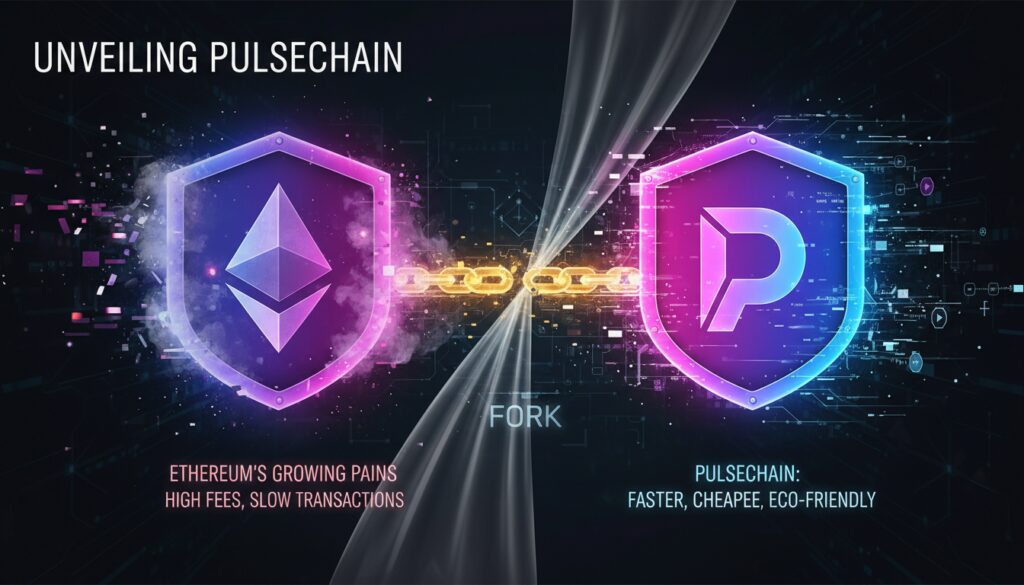
Ethereum, the undisputed king of smart contract platforms, has been a cornerstone of the DeFi revolution. Its programmable blockchain enabled countless innovations, from decentralized exchanges to NFT marketplaces. However, its immense success also exposed significant limitations.
As the network grew, so did its transaction fees, often referred to as ‘gas fees.’ During peak demand, these fees could skyrocket, making small transactions uneconomical and pricing out many potential users. Furthermore, transaction speeds often suffered due to network congestion, leading to frustrating delays.
While Ethereum’s developers are tirelessly working on scalability solutions like sharding and the transition to Proof of Stake (which has largely happened), Richard Heart saw an immediate opportunity to create a high-performance alternative that could alleviate these pain points and offer a superior user experience right from the start.
Pulsechain’s Innovative Approach: A State-Copied Hard Fork
Pulsechain isn’t just another new blockchain; it’s a direct evolution of Ethereum. A ‘hard fork’ essentially means creating a precise copy of an existing blockchain’s entire state at a specific point in time, then continuing as a separate, independent chain with its own rules and improvements.
When Pulsechain launched, it mirrored the entire state of Ethereum, meaning virtually every ERC-20 token, NFT, and other assets that existed on Ethereum were duplicated on Pulsechain. This groundbreaking feature provides instant liquidity and an immediate ecosystem for users. The original assets remain on Ethereum, while identical copies (often prefixed with ‘p,’ like pETH, pDAI) appear on Pulsechain, ready for use in its new, optimized environment.
This clever approach bypasses the need for projects to manually migrate or re-launch on a new chain, offering a relatively seamless transition for users and an immediate, vibrant dApp landscape.
Key Features Driving Pulsechain’s Promise
Pulsechain was engineered with several core objectives in mind, aiming to significantly improve upon its predecessor:
- Lower Transaction Fees: Perhaps its most celebrated feature, Pulsechain drastically reduces transaction costs by utilizing its native token, PLS, for gas fees. This makes DeFi more accessible to everyone, not just those with deep pockets, fostering greater participation in the decentralized economy.
- Faster Transaction Speeds: Through architectural optimizations and its Proof of Stake consensus mechanism, Pulsechain aims for significantly quicker transaction finality compared to Ethereum’s earlier Proof of Work iterations. This enhances user experience and enables more complex, real-time dApp interactions.
- Environmental Friendliness: Designed as a Proof of Stake (PoS) network from its inception, Pulsechain is a much ‘greener’ blockchain. It consumes vastly less energy to secure the network and process transactions than traditional Proof of Work systems, aligning with growing environmental concerns in the crypto space.
- Instant Ecosystem via State-Copy: The 1:1 duplication of Ethereum’s state means users woke up with copies of their Ethereum assets on Pulsechain. This immediately populated the network with a rich ecosystem of existing projects and liquidity, eliminating the ‘cold start’ problem faced by many new blockchains.
- PLS as the Native Utility Token: PLS serves as the gas token for all transactions on Pulsechain, similar to how ETH functions on Ethereum. Its utility is fundamental to the network’s operation, facilitating smart contract execution and network security.
Building the Ecosystem: PulseX and Beyond
A robust ecosystem is vital for any blockchain’s long-term success, and Pulsechain has built one from the ground up. Central to this is PulseX, the native decentralized exchange (DEX) designed to facilitate token swaps and provide liquidity within the Pulsechain network. PulseX is intended to offer low fees and high efficiency for trading the newly duplicated tokens and any new projects that launch directly on Pulsechain. Beyond PulseX, the vision is for developers to migrate their existing dApps or build entirely new ones directly on Pulsechain, leveraging its superior performance and lower costs.
This potential for a thriving dApp ecosystem, fueled by the copied state and new innovations, is a significant draw for users and developers alike, promising a vibrant and dynamic environment for decentralized applications.
Pulsechain’s Potential Impact on DeFi
Pulsechain’s arrival could have a profound impact on the decentralized finance landscape. By significantly lowering transaction costs and increasing speeds, it democratizes access to DeFi, allowing more users to participate in activities like lending, borrowing, staking, and yield farming without being hampered by exorbitant fees. It could foster innovation by providing a more cost-effective environment for developers to experiment and deploy new protocols.
If Pulsechain gains significant traction, it could alleviate some of the pressure on the Ethereum network, offering a viable, high-performance alternative for a wide range of DeFi applications.
Its existence challenges the status quo and pushes the boundaries of what’s possible in a truly decentralized financial system, potentially ushering in a new era of affordability and accessibility in crypto.
Navigating Challenges and the Road Ahead
Despite its ambitious goals and a passionate community, Pulsechain, like any major project, faces its share of challenges and criticisms. Skeptics often point to the influence of Richard Heart, whose previous project, HEX, has been controversial.
There are also questions about achieving true decentralization and attracting sufficient developer talent and user adoption to truly compete with established chains. The long-term success of Pulsechain will depend on its ability to sustain its performance, maintain security, and continue to innovate while building trust within the broader crypto community. As with all emerging technologies, due diligence and a balanced perspective are crucial for anyone considering engagement with the platform.
Conclusion: A New Horizon for Decentralization
Pulsechain represents a bold step forward in the evolution of blockchain technology. By taking the proven foundation of Ethereum and introducing critical enhancements like dramatically lower fees, faster speeds, and environmental efficiency, it aims to create a more accessible and powerful platform for decentralized applications.
While the journey ahead is undoubtedly complex, Pulsechain’s unique approach, coupled with its vibrant community and a clear vision, positions it as a significant contender in the race to build the next generation of decentralized finance. Its development marks an exciting chapter in the ongoing quest for a truly scalable, affordable, and user-friendly blockchain future, inviting users to explore a new horizon for decentralization.
This article was generated using the Buzz AI Growth Engine. Try it for yourself and start generating content today!