
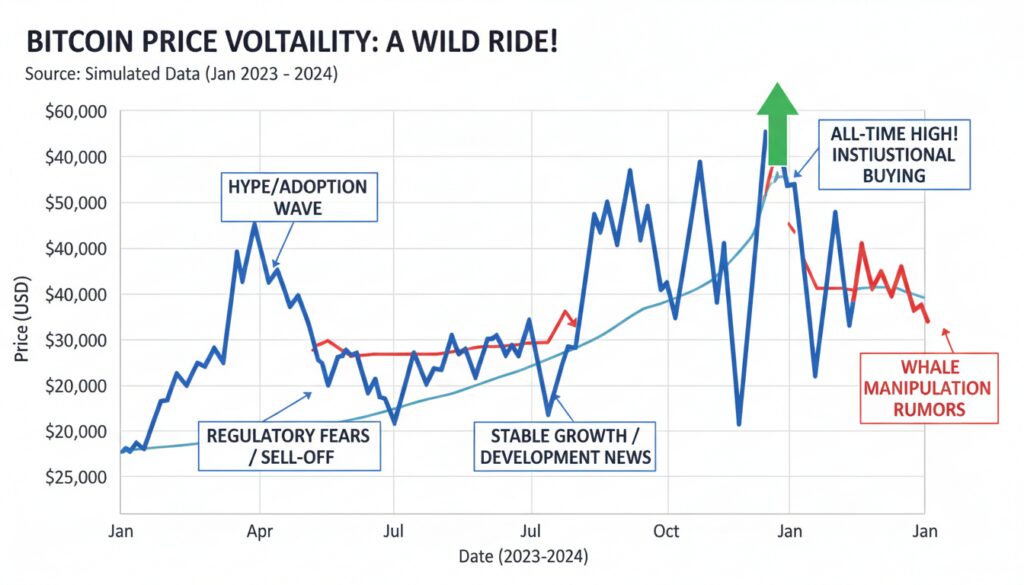
Why Do Cryptocurrencies Fluctuate? A Beginner’s Guide to Crypto’s Wild Ride!
Ever gazed at a cryptocurrency chart, watching prices rocket one moment and plummet the next, and wondered, ‘What on earth is going on?!’
You’re not alone! The world of crypto can feel like a rollercoaster designed by a mad scientist, but understanding its ups and downs isn’t as complicated as it seems.
For beginners, it’s crucial to grasp that these fluctuations aren’t random chaos; they’re driven by a fascinating mix of economics, technology, human psychology, and market dynamics. Let’s dive in and demystify why your digital assets are always on the move, using Bitcoin, Ethereum, and PulseChain as our trusty guides!
The Core Principle: Supply and Demand (It’s Not Just for Lemons!)
At its heart, cryptocurrency price fluctuation boils down to a fundamental economic principle: supply and demand. Imagine a rare, delicious lemonade stand in the scorching desert. If everyone wants that lemonade (high demand) but there are only a few cups available (low supply), the price will soar! Conversely, if everyone has had their fill and there’s a surplus of lemonade, the price will drop faster than a melting ice cube.
Cryptocurrencies work similarly. When more people want to buy a crypto asset than sell it, its price goes up. When more people want to sell than buy, the price goes down. Simple, right? But what influences these ‘wants’ and ‘don’t wants’?
The Movers and Shakers: What Drives Crypto Prices?
1. Market Sentiment & News: The Emotional Rollercoaster
Cryptocurrency markets are incredibly sensitive to news and sentiment. A tweet from a prominent figure, a regulatory announcement from a government, or even a sensational headline can send prices soaring or crashing.
This is where ‘FOMO’ (Fear Of Missing Out) and ‘FUD’ (Fear, Uncertainty, Doubt) come into play. Positive news can trigger FOMO, leading to a buying frenzy, while negative news can spark FUD, causing a sell-off. Think of it like a giant online chat group where everyone’s emotions are amplified!
2. Technological Developments & Upgrades: The Innovation Engine
The underlying technology of a cryptocurrency is a huge driver of its value. Major network upgrades, new features, or improvements in scalability and security can significantly impact a crypto’s perceived value and, consequently, its price.
For example, when Ethereum underwent its ‘Merge’ to a proof-of-stake consensus mechanism, it was a massive technological feat that aimed to make the network more energy-efficient and scalable. Expectations and the successful execution of such upgrades can lead to significant price movements.
3. Scarcity & Halving Events: Digital Gold Rush
Some cryptocurrencies, like Bitcoin, have a capped supply. There will only ever be 21 million Bitcoins. This inherent scarcity is a key part of its ‘digital gold’ narrative. Bitcoin also experiences ‘halving’ events approximately every four years, where the reward for mining new blocks is cut in half.
Historically, these events have been followed by significant price rallies, as the rate of new supply entering the market decreases, making existing Bitcoin more scarce.
4. Utility & Adoption: Real-World Use Cases
The more a cryptocurrency is actually used for something beyond just speculation, the more stable and valuable it tends to become.
Is it used for payments? For building decentralized applications (dApps)? For smart contracts? The greater the real-world utility and adoption by businesses and individuals, the higher the demand and, usually, the price. Think of it as a tool – the more useful a tool is, the more people want it.
5. Macroeconomic Factors: The Big Picture
Believe it or not, global economic trends can also sway crypto prices. When traditional markets (stocks, bonds) are volatile, some investors might flock to crypto as a hedge against inflation or economic uncertainty, viewing it as ‘digital gold.’ Others might see it as a riskier asset and pull their money out during economic downturns. Interest rates, inflation reports, and even geopolitical events can all have a ripple effect on crypto markets.
6. Liquidity & Whale Activity: The Big Swimmers
Liquidity refers to how easily an asset can be bought or sold without affecting its price. Less liquid assets can experience wilder price swings with smaller trades. ‘Whales’ are individuals or entities holding massive amounts of a particular cryptocurrency. When a whale makes a large buy or sell order, it can significantly impact the market price, especially in less liquid assets, creating significant ripples.
Crypto’s Big Three: Bitcoin, Ethereum, and PulseChain in Action
Bitcoin (BTC): The Pioneer’s Path
Bitcoin’s fluctuations are often a barometer for the entire crypto market. Its price is heavily influenced by its fixed supply (scarcity), halving events, institutional adoption (big companies buying BTC), and its narrative as a store of value or ‘digital gold.’ Macroeconomic factors, like inflation concerns, often see investors moving towards or away from Bitcoin, causing its price to react significantly.
Ethereum (ETH): The Smart Contract Powerhouse
Ethereum’s price movements are driven by its utility as the leading platform for decentralized applications (dApps), NFTs, and decentralized finance (DeFi).
Demand for ETH often correlates with activity on its network – higher usage means more ‘gas fees’ (paid in ETH) and increased demand. Its major technological upgrades, like the transition to Ethereum 2.0 (The Merge), have also been massive price drivers, reflecting the market’s confidence in its future scalability and efficiency.
PulseChain (PLS): The Up-and-Comer’s Journey
PulseChain, a newer player, is a fork of Ethereum, meaning it copied Ethereum’s entire state at a certain point. Its fluctuations are driven by slightly different factors, given its newer status. Key drivers include community enthusiasm, ongoing development (new features, dApp migration), marketing efforts, and its relationship with the existing Ethereum ecosystem.
As a relatively newer network, its price can be more volatile, heavily influenced by speculative interest, the success of projects launching on its chain, and broader market sentiment towards new, high-potential layer-1 blockchains. Its price will grow as more users and developers migrate to it and find value in its lower fees and faster transaction times compared to its parent chain.
Navigating the Waves: What Beginners Should Know
Understanding these factors doesn’t mean you can predict the future (no one can!), but it does arm you with knowledge. Cryptocurrency volatility is a feature, not a bug, of these nascent markets.
As a beginner, remember to:
- Do Your Research (DYOR): Understand what you’re investing in.
- Start Small: Don’t invest more than you can afford to lose.
- Think Long-Term: Short-term fluctuations are common; focus on the bigger picture.
- Stay Informed: Keep an eye on reputable crypto news sources, but avoid emotional trading based on hype or fear.
The world of crypto is dynamic and exciting. By understanding the forces behind its price fluctuations, you’ll be better equipped to navigate its thrilling, sometimes wild, ride!
This article was generated using the Buzz AI Growth Engine. Try it for yourself and start generating content today!