
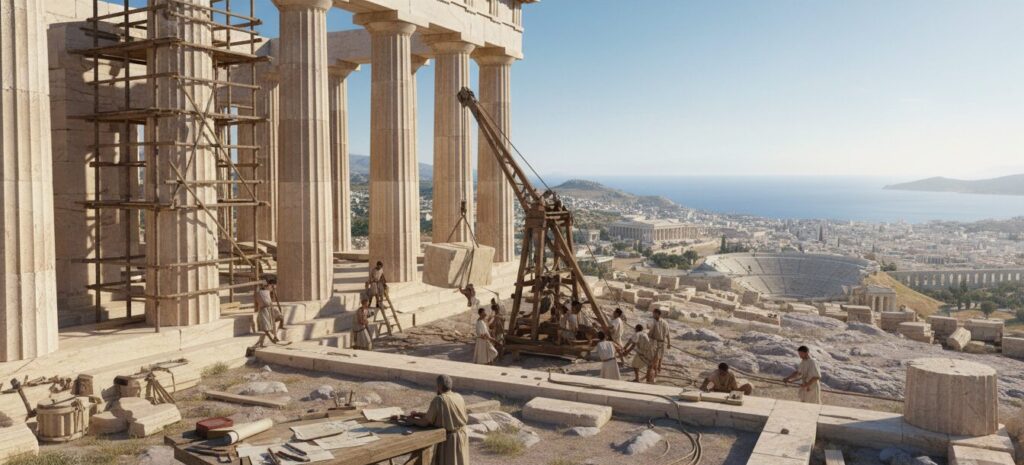
The Enduring Marvel: Construction in Ancient Greece
Step back in time to an era when colossal structures rose from the earth, not by modern machinery, but by the sheer will, ingenuity, and meticulous craftsmanship of ancient civilizations.
Ancient Greece, a cradle of democracy, philosophy, and art, was also a powerhouse of architectural and engineering innovation. The construction techniques and structures of this period continue to inspire awe and study, revealing a profound understanding of physics, aesthetics, and human potential.
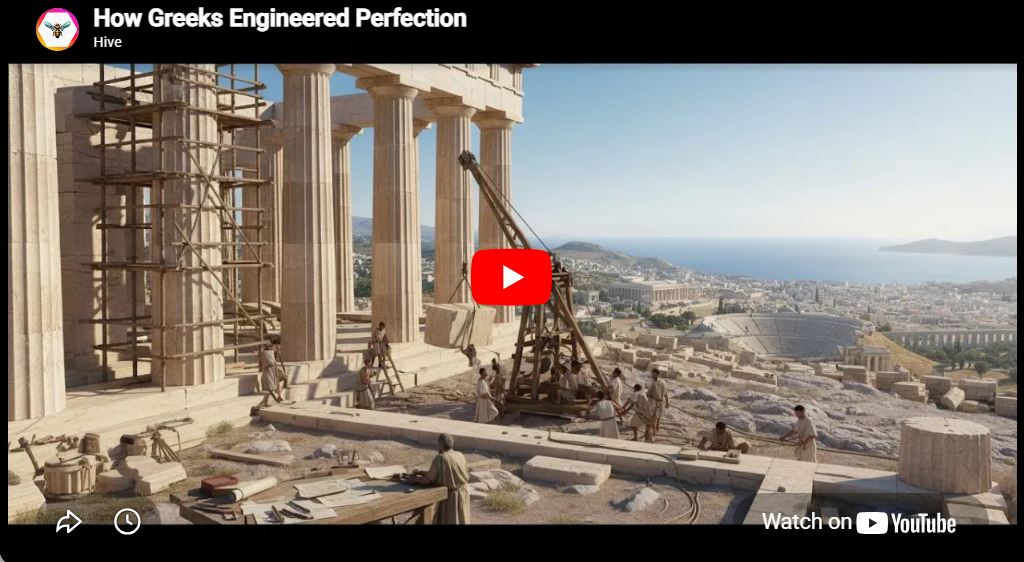
From the majestic temples atop the Acropolis to the sprawling agoras and sophisticated hydraulic systems, ancient Greek construction was a testament to a society that valued beauty, functionality, and enduring legacy.
Materials of Magnificence: Stone, Wood, and Clay
The Greeks were masters of their local resources. Marble, particularly from quarries like Penteli near Athens, was the material of choice for their most significant public buildings and temples. Its durability, workability, and luminous quality made it ideal for intricate carvings and grand facades.
Limestone was also widely used, often covered with a stucco finish to mimic marble or for less prominent structures. For foundations and basic construction, rougher local stones were employed.
Wood, while perishable, played a crucial role, especially in the early stages of construction. It was used for scaffolding, lifting mechanisms, and often for the roof structures of temples before the advent of more robust stone or tile solutions.
Terracotta, a form of fired clay, was indispensable for roofing tiles, decorative elements like antefixes and akroteria, and even for drainage pipes, demonstrating an early understanding of ceramic engineering.
Precision and Power: Techniques That Built Empires
Ancient Greek construction was characterized by its precision and the ingenious application of basic mechanical principles. The most fundamental technique was the ‘post-and-lintel’ system, where vertical supports (posts or columns) held horizontal beams (lintels).
This seemingly simple method, refined over centuries, allowed for vast, open interior spaces and the iconic colonnades we associate with Greek temples.
Moving massive blocks of stone, some weighing many tons, required sophisticated lifting mechanisms. Evidence suggests the Greeks utilized complex systems of levers, pulleys, and winches, powered by human and animal labor. Cranes, often depicted in ancient art, were likely wooden structures capable of hoisting heavy loads.
The precision with which these massive blocks were cut and fitted, often without mortar, is astounding. Dry masonry, where stones were cut so precisely that they fit together perfectly, created incredibly stable and durable structures resistant to earthquakes.
Another remarkable aspect was the use of ‘anathyrosis,’ a technique where only the edges of the stone blocks were finely dressed, leaving the central part slightly recessed.
This reduced the surface area requiring precise fitting, saving labor while still achieving a tight, stable joint. Metal clamps, usually made of iron and sometimes coated with lead for corrosion resistance, were used to secure blocks horizontally, while vertical dowels helped prevent shifting.
Architectural Orders: A Symphony of Style
Perhaps the most recognizable contribution of Greek construction is the development of the architectural orders: Doric, Ionic, and Corinthian.
These were not merely decorative styles but comprehensive systems dictating proportions, column design, and entablature. The Doric order, the oldest and most austere, is characterized by sturdy, fluted columns with plain, circular capitals.
The Ionic order introduced more slender, elegant columns with volutes (scrolls) on their capitals. The Corinthian order, the most ornate, featured capitals adorned with acanthus leaves.
These orders were applied with incredible mathematical precision and an understanding of optical illusions.
Architects like Iktinos and Kallikrates, responsible for the Parthenon, incorporated subtle curvatures and inclinations (entasis) in columns and horizontal lines to counteract the optical distortion that would otherwise make straight lines appear to sag or bulge. This meticulous attention to detail ensured that the buildings appeared perfectly straight and harmonious to the human eye.
Iconic Structures: Temples, Theaters, and Public Spaces
The most celebrated examples of Greek construction are undoubtedly its temples. The Parthenon, dedicated to the goddess Athena, stands as the pinnacle of Doric architecture, a masterpiece of proportion and engineering.
The Erechtheion, with its famous Caryatids, showcases the elegance of the Ionic order. These temples were not just places of worship but also symbols of civic pride and artistic achievement.
Beyond religious structures, the Greeks built impressive public spaces. The Agora served as the heart of city life, a marketplace, meeting place, and center for political discourse.
Stoas, long colonnaded buildings, provided shelter and space for commerce and philosophy.
The Greeks also mastered the construction of theaters, utilizing natural slopes for seating (theatron) to achieve remarkable acoustics, as exemplified by the Theater of Epidaurus, which can seat thousands and still allows a whisper on stage to be heard in the highest rows.
Furthermore, ancient Greek engineers tackled practical challenges with equal vigor. They built sophisticated aqueducts to supply cities with fresh water, constructed elaborate harbors, and developed extensive road networks.
Fortifications, such as the Long Walls of Athens, demonstrated their strategic military engineering capabilities.
The Enduring Legacy
The construction in ancient Greece was more than just putting stones together; it was an expression of their philosophical ideals, their pursuit of perfection, and their deep respect for harmony and order.
The principles and techniques they pioneered laid the groundwork for much of Western architecture and engineering. Roman builders, for instance, heavily borrowed from Greek precedents, adapting and expanding upon them.
Today, the ruins of ancient Greek structures continue to captivate and educate.
They stand as silent witnesses to a civilization that, with relatively simple tools and immense intellectual power, achieved feats of construction that still challenge modern understanding.
The legacy of ancient Greek builders is not just in the stones they laid, but in the enduring principles of design, precision, and the pursuit of excellence that continue to shape our built world.
This article was generated using the Buzz AI Growth Engine. Try it for yourself and start generating content today!
When I was a child I thought history was boring! That wasn’t entirely my fault, it was the way it was taught in the standard educational system. With the advent of the internet and AI we have discovered wider world views and more intelligence amongst the populations with the ability to discern what is truth/fake. So much to keep one occupied. Thanks for this article!