
TL;DR
(Short on time? Read our Too Long; Didn’t Read)
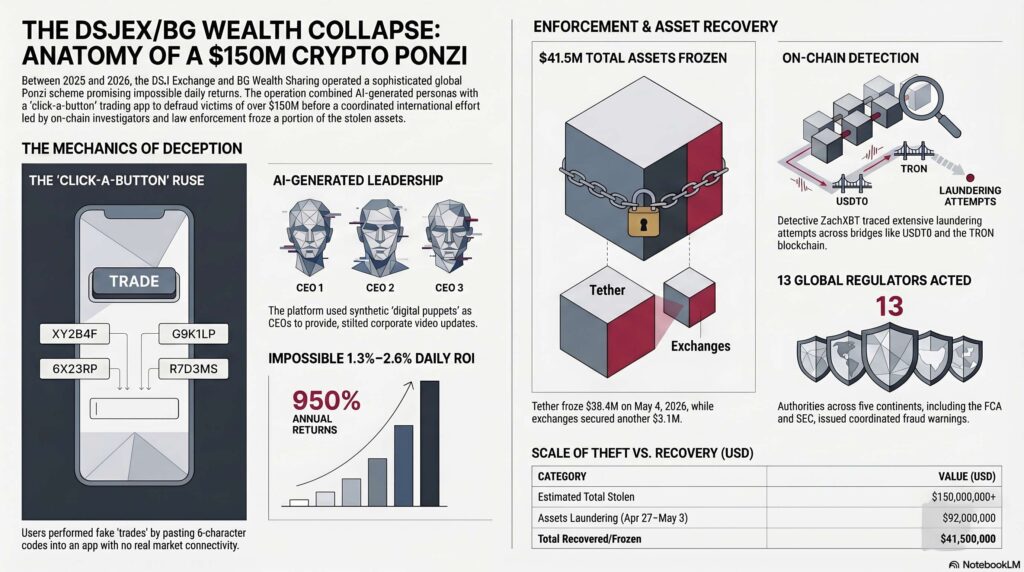
BG Wealth Sharing, closely tied to the fake trading platform DSJ Exchange (DSJEX), emerged as one of the more prominent “click-a-button” investment schemes in the cryptocurrency space starting primarily in 2025. Promising daily returns of 1.3–2.6%, referral commissions, and tiered rewards through a recruitment-heavy model, the operation allegedly defrauded users of over $150 million. The scheme collapsed in late April/early May 2026 with a classic rug pull: frozen withdrawals, demands for a fake 12% “tax” or fees, and eventual seizure of its main website by US authorities (FBI/DOJ/Secret Service).
On-chain investigator ZachXBT played a pivotal role in tracing funds, leading to the freezing of approximately $41.5 million in coordination with Tether (freezing ~$38.4M USDT), Binance security, OKX, and US law enforcement. Scammers attempted to launder over $92 million across chains post-collapse.
This report examines the scheme’s structure, operational tactics, regulatory warnings across five continents, the mechanics of its collapse, victim impact, and broader lessons for the crypto ecosystem. It draws on regulatory alerts, on-chain analysis, investigative journalism, and community reports.
Origins and Operational Model
BG Wealth Sharing positioned itself as a hedge fund and investment group, often claiming roots back to 2018 and affiliations with major institutions like the IMF or Investing.com. These claims were fabrications. The primary public face was a fictional CEO, “Professor Stephen Beard,” portrayed as a British finance expert with degrees from Oxford Brookes University and experience at Gemini exchange. Investigations, including by BehindMLM and community sleuths, found no verifiable record of such a person outside the scheme’s materials; his persona appears to be entirely fabricated or AI-assisted.
The investment flow was straightforward and predatory:
- Users deposited USDT (primarily on Tron) into the DSJ Exchange app/platform.
- They received daily “trading signals” via BonChat, Telegram (e.g., @BG_Stephen, @Elena1992818), or similar apps.
- Investors “clicked buttons” in a dummy trading interface to execute fake trades, generating illusory profits displayed on the platform.
- Higher tiers or more recruitment unlocked better signals/rewards.
Compensation Structure (per BehindMLM analysis):
- Investment tiers: $500, $1,000, $3,000, $5,000 USDT.
- Daily ROI promises: 1.3–2.6%.
- Referral commissions: e.g., $100 for recruiting a $1,000 investor.
- Rank achievement bonuses up to $25,000+ for high-level recruiters (e.g., Regional Spokesperson requiring 5,000 downline members).
This model combined elements of a Ponzi (new deposits funding “returns”) with multi-level marketing (MLM) recruitment pressure. No real trading occurred; on-chain evidence showed internal cycling and skimming. The platform used rotating domains (e.g., bggp.vip, dsjex.net variants, dsjzn.com) to evade takedowns, with Chinese-language elements in source code pointing to operators with ties to Chinese cybercrime networks operating from scam compounds in Southeast Asia.
DSJ Exchange itself was a shell: a fake interface with no legitimate liquidity, trading volume, or regulatory oversight. It funneled users into the app while BG Wealth handled recruitment hype.
Global Reach and Victim Demographics
The scheme targeted diaspora communities, particularly Pacific Islanders (Tonga, Samoa, New Zealand), the Philippines, and others in the US, Canada, UK, and Australia. Social media (Facebook groups), WhatsApp, BonChat, and Zoom sessions amplified recruitment. Promoters often used cultural trust and community networks, framing it as a path to financial freedom.
Estimates suggest thousands of victims across 100+ countries, with total inflows exceeding $150 million. Many early participants received small withdrawals to build credibility (a classic Ponzi tactic), encouraging larger deposits and aggressive recruitment. Losses disproportionately affected middle- and lower-income families lured by “guaranteed” returns amid economic pressures.
Regulatory Warnings: A Multi-Continent Response
Regulators issued warnings months (and in some cases over a year) before the collapse, highlighting the scheme’s unregistered status and fraudulent claims:
Canada: Alberta Securities Commission (ASC) warned in February 2026; echoed by other provinces.- US: Washington DFI (April 2026, updated May), Utah Division of Securities, and others. Noted fake SEC filings (Exempt Reporting Adviser status misused).
- UK: FCA warning on BG Wealth Sharing / dsjex.net (May 2025).
- Pacific: New Zealand FMA, Tonga Reserve Bank (Dec 2025), Samoa Central Bank.
- Philippines: SEC warnings.
At least 13 regulators across five continents flagged it. Despite this, the operation persisted through domain rotations and continued hype.
These alerts emphasized red flags: guaranteed returns, pressure to recruit, private chat communication, and lack of verifiable licensing.
Collapse and Law Enforcement Action (Late April/Early May 2026)
The scheme showed strain in early 2026 with reports of frozen accounts for heavy withdrawers. By late April, withdrawals halted entirely, followed by demands for a 12% “tax” or fees to “release” funds or facilitate an alleged IPO/audit. This advance-fee tactic is standard in exiting Ponzis.
The main site (bgwealthsharing.com) was seized by US authorities around May 4, 2026, with DNS pointing to fbi.seized.gov infrastructure. Scammers initially claimed a “hack,” but technical evidence confirmed law enforcement action.
ZachXBT’s Investigation:
ZachXBT detailed the collapse on X (May 5, 2026), tracing $92M+ in laundering attempts (April 27–May 3) via swaps, bridges, USDD wrapping, and hundreds of addresses. Coordination with Tether, Binance, OKX, and US LE resulted in $41.5M frozen ($38.4M by Tether on Tron). He urged victims to file reports (e.g., ic3.gov for US).
Much of the funds are likely dissipated, but freezes offer partial recovery potential for some.
Key Takeaways and Characteristics of the Fraud
- Classic Ponzi Traits: Unsustainable returns funded by new capital; recruitment as the lifeblood; eventual liquidity crisis.
- Tech-Enabled Deception: Fake dashboards, signals, rotating infrastructure, and cross-chain obfuscation.
- Psychological Manipulation: Fictional authority figure (“Professor”), community pressure, fear of missing out (FOMO), and post-collapse recovery scams.
- Links to Organized Crime: Part of a wave of Chinese-operated “click-a-button” Ponzis, often tied to Southeast Asian scam compounds involving human trafficking.
Similar schemes (e.g., TXEX, MTS Foundation) follow the same playbook and collapse cyclically.
Victim Impact and Recovery Challenges
Victims face total or near-total loss of deposits. Emotional toll includes betrayal by community recruiters (some of whom profited and may face clawbacks). Recovery scams proliferate, promising to “unlock” funds for more fees.
Advice for victims:
- Document all transactions, screenshots, and communications.
- Report to local police, securities regulators, and platforms (e.g., FBI IC3).
- Avoid paying any “taxes” or recovery fees.
- Seek legitimate legal/financial advice; collective actions may help in some jurisdictions.
Clawback risks exist for net winners/recruiters in certain countries (e.g., Canada).
Broader Implications for Crypto and Regulation
This case underscores persistent vulnerabilities:
- Crypto’s Double-Edged Sword: Pseudonymity and cross-border ease enable fraud, but on-chain transparency (via analysts like ZachXBT) aids enforcement.
- Stablecoin Role: Heavy USDT/Tron usage highlights risks in dominant stablecoins, though Tether’s cooperation shows improving industry response.
- Regulatory Gaps: Slow international coordination allows schemes to thrive until collapse. Fake filings exploit SEC exemptions.
- Social Media Amplification: Platforms must improve detection of coordinated hype.
- Investor Education: “Guaranteed” high yields in crypto are red flags. Due diligence (DYOR) must include regulatory checks.
Positive developments include faster freezes and seizures, signaling maturing law enforcement tools.
Conclusion
BG Wealth Sharing / DSJEX exemplifies modern crypto fraud: blending MLM recruitment, fake tech interfaces, and social engineering. Its rapid growth to $150M+ and multi-continental warnings followed by swift collapse and partial asset recovery highlight both the problem’s scale and improving defenses.
Ultimately, sustainable wealth in crypto comes from transparent projects and risk management—not “click-a-button” promises. Victims deserve support and potential restitution where possible, while the incident serves as a stark reminder: if returns sound too good to be true, they almost always are. The fight against such schemes requires continued vigilance from regulators, investigators, platforms, and the community.
References and Citation List
- ZachXBT threads and reports (May 2026) via RootData, CryptoTimes, etc.
- Washington DFI Alert (April/May 2026).
- Alberta Securities Commission warnings (Feb 2026).
- BehindMLM Review (Sep 2025, updates 2026).
- FCA, FMA, Tonga NRBT, Samoa CBS, Philippines SEC alerts (2025–2026).
- Reddit r/CryptoScams discussions and victim reports (2025–2026).
- BitPinas and other news on website seizure.
- Additional sources: MEXC News, OurCryptoTalk, DeHek investigations.
All information is based on publicly available reports as of May 6, 2026. This is not legal or financial advice.
This industry is so complicated and it’s so important to seek the knowledge and understanding before venturing into these schemes, be very careful of those greedy scammers.
Very good article
Thanks for your reply and yes, you are correct. There are a lot of things to learn in this industry and scammers are always trying new ways to commit fraud.
It’s best to learn as much as possible and keep on learning, to reduce the likelihood of getting scammed.