
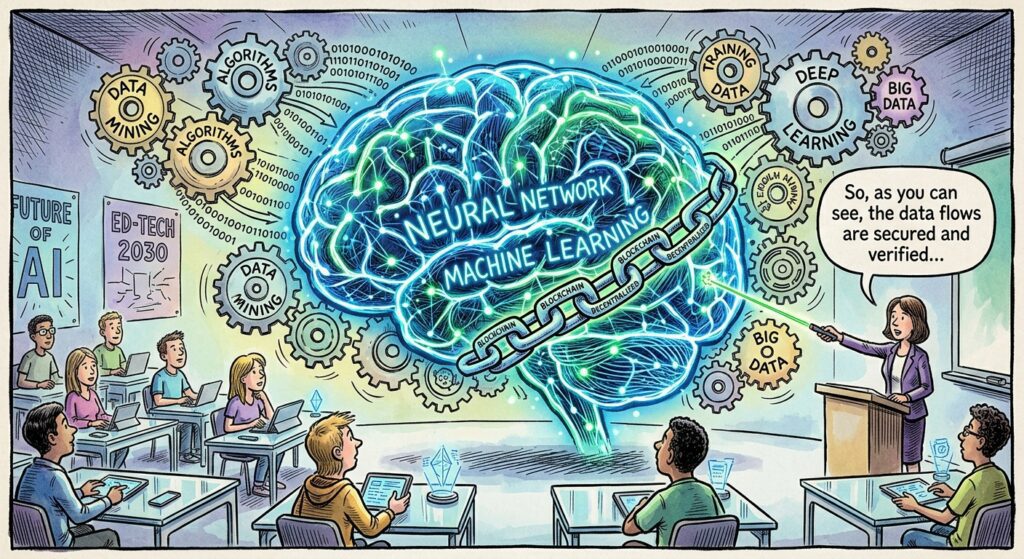
Beyond the Basics: Advanced Neural Networks and Machine Learning
Neural networks are computational models inspired by the human brain, designed to recognize patterns and make decisions, while machine learning encompasses the broader field of algorithms that allow systems to learn from data without explicit programming. Beyond the basics, understanding these fields involves delving into advanced architectures, diverse learning paradigms, and their intricate applications, which are increasingly crucial in our digital economy.
The Evolution of Neural Networks: From Perceptrons to Deep Learning
At Hive (HAiV3) HEXucation A.i. V3, we recognize that while the concept of a single-layer perceptron provides a foundational understanding, the true power of neural networks emerges with more complex architectures. Deep learning, a subset of machine learning, leverages neural networks with multiple hidden layers to model intricate patterns in data.
Multilayer Perceptrons (MLPs) and Activation Functions
Multilayer Perceptrons (MLPs) are the bedrock of many deep learning models. Unlike a single perceptron, MLPs can learn non-linear relationships through the introduction of one or more hidden layers and non-linear activation functions (like ReLU, sigmoid, or tanh). Each neuron in a hidden layer processes inputs from the previous layer, applies an activation function, and passes its output to the next layer. This layered structure allows MLPs to approximate any continuous function, making them incredibly versatile for tasks like classification and regression.
Convolutional Neural Networks (CNNs) for Spatial Data
For processing spatial data such as images, Convolutional Neural Networks (CNNs) are unparalleled. CNNs employ specialized layers like convolutional layers, pooling layers, and fully connected layers. Convolutional layers use learnable filters (kernels) to detect features like edges, textures, or specific patterns across different parts of an image. Pooling layers then reduce the dimensionality, helping to make the network robust to minor shifts or distortions. This hierarchical feature extraction makes CNNs highly effective for image recognition, object detection, and even medical imaging analysis.
Recurrent Neural Networks (RNNs) for Sequential Information
When dealing with sequential data like text, speech, or time series, Recurrent Neural Networks (RNNs) come into play. RNNs possess internal memory, allowing them to retain information from previous steps in a sequence. This “memory” enables them to understand context and dependencies over time. While basic RNNs can struggle with long-term dependencies (the vanishing/exploding gradient problem), advancements like Long Short-Term Memory (LSTM) networks and Gated Recurrent Units (GRUs) have largely mitigated these issues, making them powerful for natural language processing, speech recognition, and stock market prediction.
The Broader Machine Learning Landscape
Beyond neural networks, machine learning encompasses a vast array of algorithms categorized by their learning paradigm:
- Supervised Learning: Uses labeled datasets to train models to predict outcomes. Examples include linear regression, support vector machines (SVMs), and decision trees.
- Unsupervised Learning: Works with unlabeled data to discover hidden patterns or intrinsic structures. Clustering algorithms (k-means) and dimensionality reduction techniques (PCA) are common examples.
- Reinforcement Learning: Involves an agent learning to make decisions by performing actions in an environment to maximize a cumulative reward. This is crucial for robotics, game playing, and autonomous systems.
The convergence of advanced neural networks with blockchain technology, a field we explore extensively at Hive, isn’t just about efficiency; it’s about creating a new era of decentralized AI. Imagine models that can be collaboratively trained, verified, and even owned by communities, fostering true data sovereignty and rewarding participation — aligning perfectly with our “Learn, Share, Earn” philosophy.
Conclusion
Mastering neural networks and machine learning beyond the basics means appreciating the architectural nuances of CNNs and RNNs, understanding the diverse learning paradigms, and recognizing their transformative potential across industries. These technologies are not just theoretical constructs; they are reshaping our world, from FinTech to marketing and entrepreneurship. At Hive (HAiV3) HEXucation A.i. V3, we empower you to dive into this fascinating, ever-evolving realm of Artificial Intelligence, helping you to learn, build, and explore the future of AI.
From Beginner To Advanced, Hive Is The Crypto, Blockchain & A.I. Learning Community For You. Explore our comprehensive paths and get started today: https://haiv3.com/aff/2
Frequently Asked Questions
What are the main types of advanced neural networks?
Beyond basic perceptrons, the main types include Multilayer Perceptrons (MLPs) for general non-linear tasks, Convolutional Neural Networks (CNNs) for spatial data like images, and Recurrent Neural Networks (RNNs) — including LSTMs and GRUs — for sequential data such as text or speech.
How do CNNs differ from MLPs?
CNNs are specifically designed for processing grid-like data (e.g., images) using convolutional and pooling layers to detect local patterns and reduce dimensionality, making them efficient for spatial hierarchies. MLPs are more general-purpose networks that connect every neuron in one layer to every neuron in the next, lacking the spatial awareness inherent in CNNs.
What is the role of activation functions in neural networks?
Activation functions introduce non-linearity into neural networks, enabling them to learn and model complex, non-linear relationships in data. Without them, even a deep neural network would behave like a simple linear model, severely limiting its capability to solve real-world problems.
How does Hive (HAiV3) support learning in AI?
Hive (HAiV3) HEXucation A.i. V3 offers comprehensive courses and resources to dive into Artificial Intelligence, from foundational concepts to advanced applications. We provide tailored learning journeys, an AI-Powered Growth Tool (Buzz) for content creation, and opportunities to create and earn from your own courses, all within a community focused on Web3, Crypto, and A.i. technologies.