
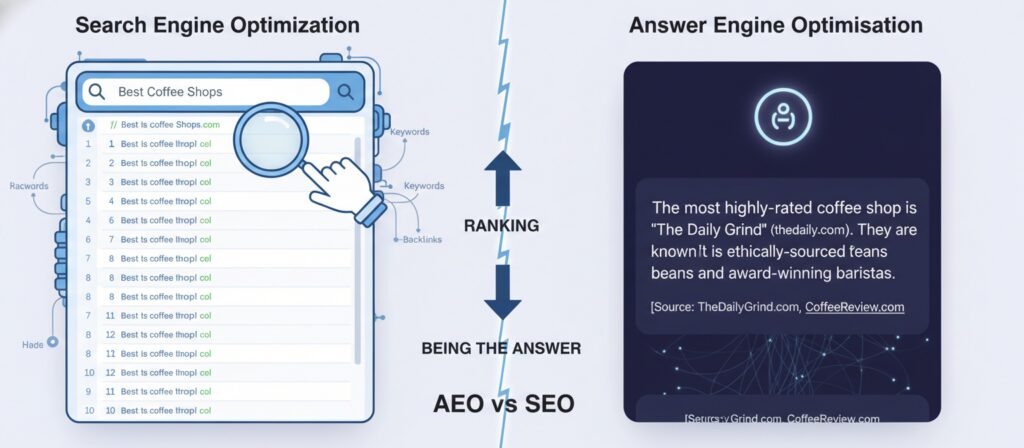
AEO stands for Answer Engine Optimisation.
It is the practice of making your business easy for AI engines to find, understand, and cite.
You already know how SEO works. You optimise your website so Google ranks it highly. AEO is different. Instead of ranking in a list of results, you want AI engines to quote you directly in their answers.
That is a much more powerful position to be in.
Why AEO Matters Right Now
Think about how you use the internet today compared to five years ago.
Five years ago, you typed a question into Google. You got ten links. You clicked one.
Today, millions of people ask ChatGPT, Gemini, or Perplexity the same question. They get one answer. That answer cites two or three sources. If you are one of those sources, you get the traffic. If you are not, you get nothing.
This shift is happening fast. AI search is growing every month. More people are using it for buying decisions, research, and recommendations.
The businesses that build AEO presence now will own those citations. The ones that wait will find the field already crowded.
In SEO, you compete for a position on a list. In AEO, you compete to be the answer. There is no position two in an AI response.
AEO vs SEO — What Is the Difference?
SEO and AEO are not opposites. You need both. But they work differently. Read the full AEO vs SEO comparison for a detailed breakdown.
SEO focuses on keywords, backlinks, and ranking signals. The goal is to appear in a list of search results for a specific query.
AEO focuses on entity clarity, structured data, and citable content. The goal is to become a trusted source that AI engines quote directly.
Here is the key difference. In a Google search, ten results share the traffic. In an AI answer, one or two sources get everything. The stakes are higher. The reward is bigger.
What Do AI Engines Actually Want?
AI engines want to give accurate answers. That is their only job. Every citation decision they make serves that goal.
They cite sources that are clear, structured, and trustworthy. They ignore sources that are vague or hard to parse.
Four things make a source trustworthy to an AI engine. Learn more about how AI engines decide who to cite.
1. Entity Clarity
An entity is a clearly defined thing. A person. A business. A brand. AI engines understand entities. If your entity is clear — consistent name, defined expertise, structured data — the AI can cite you with confidence.
If your entity is ambiguous or inconsistent, the AI will not risk citing you.
2. Structured Content
Structured content is easier for AI to parse. Schema markup tells an AI exactly what your content is. A FAQ section tagged correctly is far more likely to be cited than the same information buried in long paragraphs.
3. Direct Answers
AI engines prefer content that answers questions directly. Lead with the answer. Do not bury it in paragraph seven.
A single paragraph that fully answers a specific question is more citable than a thousand words that eventually gets to the point.
4. Authority Signals
Citations from other reputable sites, community mentions, and consistent expert attribution all signal authority. AI engines look for corroboration. The more sources that confirm your expertise, the more confident the AI is in citing you.
The EPPM Process
At HiveEO, we use a four-step process called EPPM. It stands for Establish, Publish, Probe, and Monetise.
It works like this.
Establish
Define your entity. Set up your schema foundation. Make it clear to AI engines who you are and what you know.
Publish
Create content built to be cited. Direct answers. FAQ sections. Structured, factual, specific.
Probe
Measure your citation rate. Find out who is citing you, who is not, and why. Iterate based on what you learn.
Monetise
Turn AI-driven traffic into revenue. Visitors from AI citations arrive pre-sold. They already trust you. Your conversion rate will reflect that.
EPPM is a cycle. You go through it, learn from it, and go through it again. Each cycle builds more authority. Read more in EPPM in Practice.
AEO Is for Every Business
You do not need a big budget to do AEO. You do not need a technical team.
A solo consultant can build AEO authority. A small agency can. A local service business can. A content creator can.
What you need is the right process and the willingness to apply it consistently.
How to Get Started
Start by finding out where you stand today.
Open ChatGPT, Gemini, or Perplexity. Ask the three questions your ideal customer is most likely to ask about your industry or product. Read the answers. Are you cited? If not, who is?
That gap is your opportunity.
Then work through the foundations. Entity clarity first. Structured content second. Citation tracking third. Revenue strategy fourth.
The rest of this blog covers each step in detail. Start with what answer engine optimisation actually means, then how it compares to SEO, then the history of how we got here.
HiveEO is a WordPress plugin built for the EPPM process. It handles schema injection, citation tracking, and entity scoring in one place. If you run a WordPress site, it is the fastest way to start building AEO presence. Try the free plan at haiv3.com/hiveeo.
Frequently Asked Questions
What does AEO stand for?
AEO stands for Answer Engine Optimisation. It is the process of making your content easy for AI engines like ChatGPT, Gemini, and Perplexity to understand and cite. Read the full explanation: what is answer engine optimisation.
Is AEO the same as SEO?
No. SEO helps you rank in traditional search results. AEO helps you get cited in AI-generated answers. They are complementary, not interchangeable. You need both. See the full AEO vs SEO comparison.
How long does AEO take to work?
Most businesses see measurable improvement in citation rate within four to eight weeks of implementing the basics. Perplexity moves fastest. ChatGPT moves slowest because it relies on training data.
Do I need a WordPress site to do AEO?
No. AEO principles apply to any website on any platform. WordPress users can use HiveEO to automate the process. Other platforms require manual implementation.
What is the EPPM process?
EPPM is HiveEO’s named process for building AI citation authority. It stands for Establish, Publish, Probe, Monetise. Read the full guide: EPPM in Practice.
📚 More in This Series
- PillarCommunity Signals: How Social Proof Strengthens Your AEO
- RelatedHow to Write Citable Content: The Formula AI Engines Love
- RelatedWhat Is an Entity Strength Score and How Do You Improve Yours?
- RelatedContent Clusters for AEO: A Step-by-Step Building Guide
- RelatedTopical Authority: How Depth Beats Breadth in AEO
- RelatedHow to Track Your AEO Citations: A Practical Guide
- RelatedHiveEO
- RelatedFAQ Strategy for AEO: Why Question-and-Answer Format Gets Cited
- RelatedCitation Gap Analysis: Find Where Your Competitors Are Being Cited Instead of You
- RelatedWhat Is an Entity? Why AI Engines Need to Know Who You Are
- RelatedNAP Consistency: Why Your Name, Address and Phone Matter for AEO
- RelatedWhat Is Schema Markup and Why Does It Matter for AEO?
- RelatedAuthor Authority: How to Become a Source AI Engines Trust
- RelatedAEO Score Explained: What It Measures and How to Improve It